The days of assuming one artificial intelligence model can handle every task equally well are officially over. A couple of years ago, most users defaulted to whichever chatbot launched first or went viral on social media. Today, power users, software engineers, copywriters, and students maintain active tabs for multiple AI platforms simultaneously.
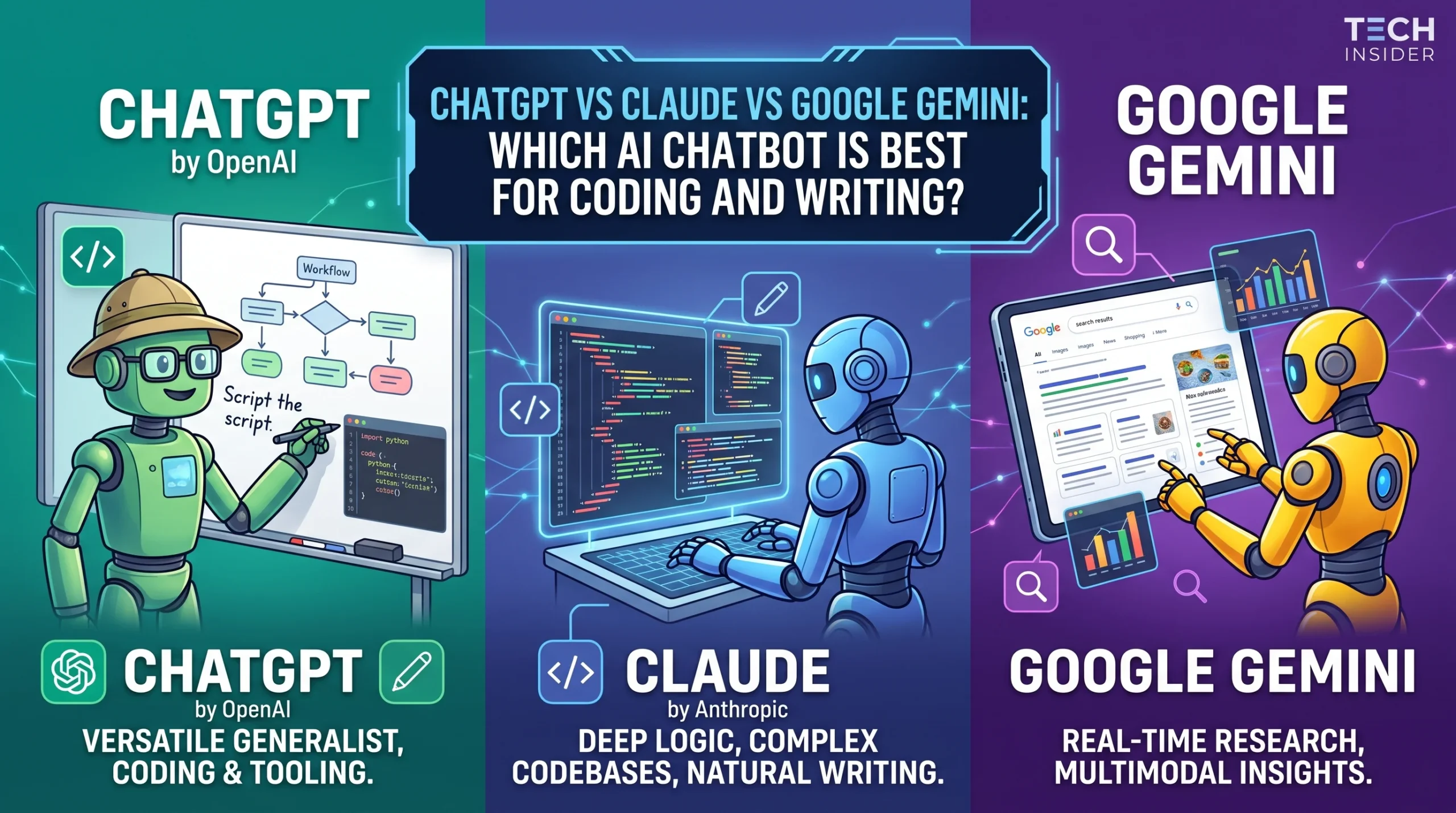
People constantly ask me which AI tool is ‘the best,’ but the reality is they have quietly specialized into very different roles. Claude is the patient architect and senior editor. ChatGPT is the fast, versatile Swiss Army knife with tools you can actually run. Gemini is your research assistant with direct access to Google’s live index. Before you blindly drop $20 a month on another subscription, just test your actual daily work on their free tiers for a couple of days. You’ll notice within 48 hours which one actually saves you time and which one just makes you re-type your prompts
The market has splintered. While OpenAI’s ChatGPT kicked off the generative AI boom, Anthropic’s Claude and Google’s Gemini have matured into distinct powerhouses with unique architectural philosophies. Because subscription costs add up quickly and context-switching between platforms drains productivity, deciding where to invest your workflow matters.
To cut through the marketing benchmarks, here is an honest, real-world comparison of how ChatGPT, Claude, and Google Gemini perform across the two most demanding AI use cases: coding and long-form writing.
1. Coding: Logic, Debugging, and System Architecture
Writing clean code requires more than just autocomplete; it demands deep logical reasoning, precise syntax compliance, and the ability to hold large software architectures in working memory without hallucinating library methods.
OpenAI ChatGPT
Primary Strength: Versatility, execution, and tooling.
The Experience: ChatGPT remains the Swiss Army knife of developer tools. Its standout feature for developers is the sandboxed code interpreter environment, which can write, run, and iteratively debug Python code in real time before returning output to you.
Where It Excels: If you need to prototype an isolated script, build a data-analysis pipeline, create regular expressions, or debug common error traces across popular stacks (JavaScript, Python, C#, Go), ChatGPT is reliable and fast. Its plugin ecosystem and custom GPTs also allow direct integration with tools like GitHub.
Where It Falls Short: ChatGPT can become lazy with verbose codebases, frequently abbreviating critical sections with comments like // implement logic here. It also tends to struggle when balancing complex dependencies across multiple distributed files.
Anthropic Claude
Primary Strength: Complex logic, massive codebases, and architectural design.
The Experience: Among senior engineers and full-stack developers, Claude has become an indispensable powerhouse. Anthropic built Claude with nuanced reasoning and a massive context window, meaning you can drop entire documentation sets, API schemas, or multi-file repositories into a single prompt.
Where It Excels: Claude writes complete, functional code without taking shortcuts. It rarely truncates logic with placeholders. It is exceptional at refactoring messy legacy code, debugging subtle race conditions, and following complex multi-step system prompts. When building web frontends or interactive components, its code generation is often production-ready on the first pass.
Where It Falls Short: Claude lacks native terminal execution inside the basic chat interface; it generates the code, but you must run and test it in your own local environment.
Google Gemini
Primary Strength: Native multimodal input and deep ecosystem integration.
The Experience: Gemini operates on a different axis. Backed by Google’s vast search index and multi-million-token context windows, Gemini shines when your coding tasks require processing external reference material.
Where It Excels: You can feed Gemini an entire 40-minute video lecture on a new framework, a 300-page API manual, or screenshots of broken user interfaces alongside logs, and it will diagnose layout issues directly from visual assets. For Google Cloud developers or those working inside Google Colab, its integrations provide seamless workflow friction reduction.
Where It Falls Short: In pure algorithmic grit and raw edge-case reasoning, Gemini occasionally produces subtle syntax drift or suggests deprecated library versions compared to Claude’s pinpoint accuracy.
2. Writing: Nuance, Style, Tone, and Voice
Automated text generation is cheap; compelling, human-sounding prose is rare. The telltale signs of AI writing—overused buzzwords like delve, testament, tapestry, and repetitive syntactic rhythms—plague unrefined models. Here is how they stack up when asked to produce polished, natural language.
Anthropic Claude
The Gold Standard for Human Tone: If you ask professional authors, editors, and senior copywriters which model they use, Claude wins by a wide margin. Anthropic tuned its models to sound remarkably natural, self-aware, and rhythmically varied.
Nuance and Voice: Claude understands subtext, dry humor, conversational pacing, and emotional resonance. When tasked with writing an editorial, an essay, or a story, it avoids robotic formulaic openings and boilerplate conclusions. It actively follows instructions regarding pacing, active voice, and vocabulary constraints.
Editing Depth: Drop a 10,000-word manuscript draft into Claude, and it can analyze thematic consistency, identify character voice drift, and provide developmental edits that read like feedback from an experienced human editor.
OpenAI ChatGPT
The Structured Workhorse: ChatGPT is an exceptionally capable drafting engine, but it carries a recognizable default cadence. It loves introductory throat-clearing, transitional signposts (“Furthermore,” “In addition”), and tidy five-paragraph essay formats.
Where It Excels: For structural ideation, outlining, business correspondence, transactional emails, and standard corporate reporting, ChatGPT is dependable. It takes explicit instructions well: if you supply reference text and demand a specific style guide, it can adapt its tone effectively.
The Challenge: Without precise and strict negative prompting (e.g., “Do not use metaphors, do not summarize at the end, avoid formal transitions”), ChatGPT’s raw output sounds distinctly synthetic and requires substantial manual polishing.
Google Gemini
The Research-Backed Informant: Gemini’s writing voice sits comfortably between ChatGPT’s corporate efficiency and Claude’s organic prose. Its secret weapon is real-time connectivity to Google Search.
Where It Excels: When writing timely blog posts, newsletter roundups, product summaries, or news syntheses, Gemini brings up-to-the-minute factual accuracy that offline or delayed models cannot match without browsing add-ons. It can scan dozens of live web sources and draft an informative synthesis in seconds.
The Challenge: Gemini’s creative writing can feel somewhat surface-level and risk-averse. Its prose prioritizes clarity and speed over evocative cadence or literary depth.
Rather than trying to force one model to handle every workflow, match the tool to your primary daily output:
Choose Anthropic Claude if: Your day revolves around serious programming or nuanced writing. If you write production code, refactor large modules, draft essays, write creative literature, or edit long manuscripts, Claude produces the cleanest, most organic, and intellectually rigorous results.
Choose OpenAI ChatGPT if: You need an all-round companion with powerful built-in execution tools. If you run interactive data analysis, need to generate scripts that execute directly in the browser, build automated agents, or rely heavily on third-party integrations, ChatGPT remains the most versatile daily driver.
Choose Google Gemini if: Your work is research-intensive and tied to live information. If you frequently analyze live web events, process massive PDFs alongside video or audio recordings, or live inside Google Docs, Sheets, and Drive, Gemini offers unbeatable multimodal processing and research velocity.
The smartest professionals do not pick a single team; they recognize that Claude is the master writer and architect, ChatGPT is the operational Swiss Army knife, and Gemini is the ultimate real-time research engine.

 1