

 11
11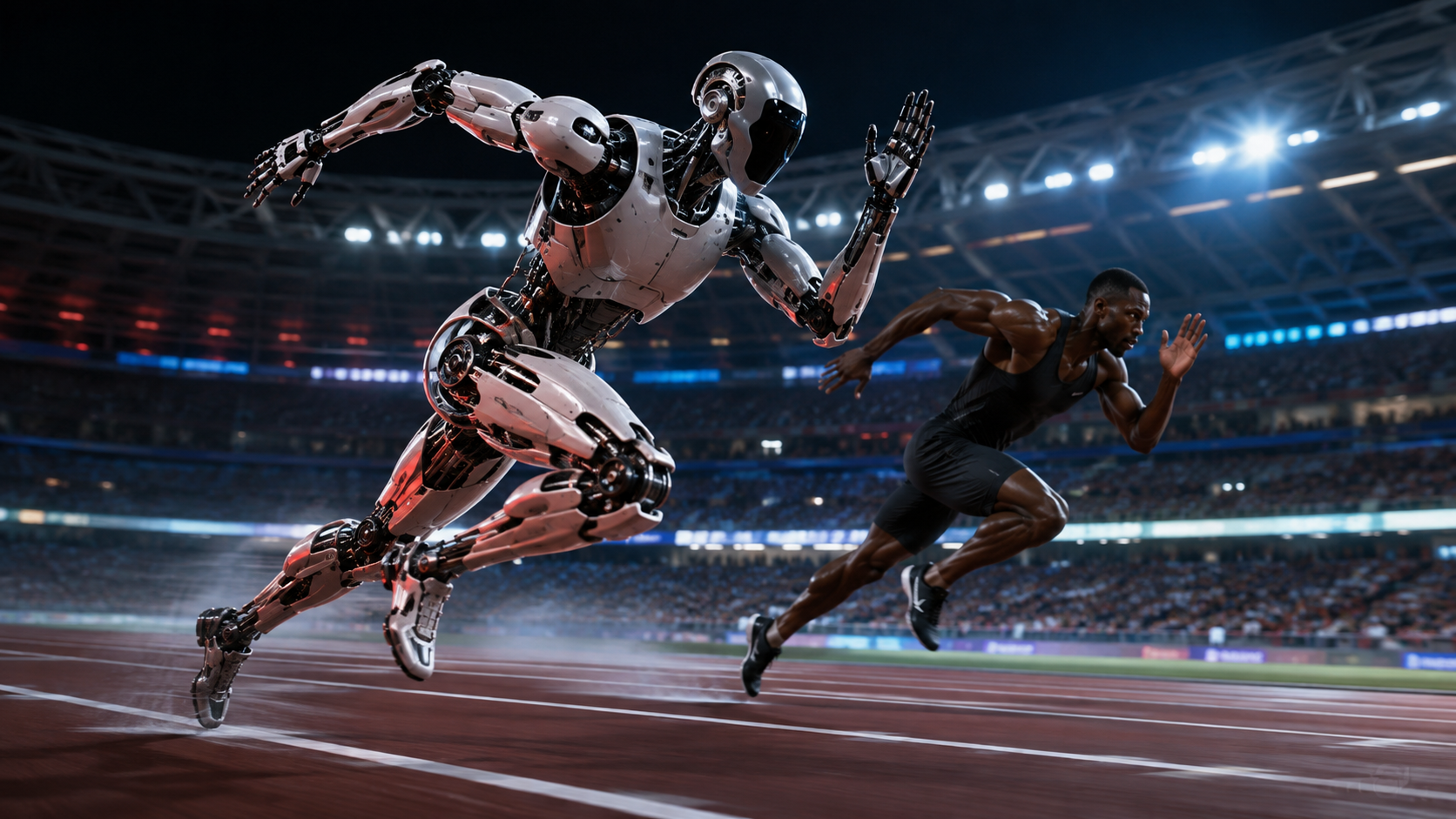
For years, Usain Bolt’s 100-meter record represented the outer edge of human speed. Now, a machine has crossed that line. At the World Humanoid Robot Games in Beijing, China’s Tiangong Ultra humanoid robot completed the 100 meters in 9.39 seconds, beating the 9.58-second human world record set by Jamaican sprinting legend Usain Bolt in 2009. But this is not simply another robot competition result. It is a glimpse into a future where artificial intelligence, advanced robotics and physical machines are beginning to compete in areas once considered uniquely human. And perhaps most strikingly, this was not a perfectly smooth victory.
Tiangong Ultra initially fell behind Honor’s humanoid robot Lightning before accelerating and overtaking it near the finish line. Lightning still finished in an astonishing 9.47 seconds, also faster than Bolt’s human record. The numbers are extraordinary. But what they represent may be even more consequential.
The race took place during the opening day of the second World Humanoid Robot Games in Beijing. Tiangong Ultra, developed by the Beijing Humanoid Robot Innovation Center, crossed the finish line in 9.39 seconds. That is 0.19 seconds faster than Bolt’s official 9.58-second record. At first glance, that may sound like a tiny difference. In elite sprinting, however, fractions of a second can separate history from ordinary competition.
Bolt established his record at the 2009 World Athletics Championships in Berlin, and it has remained one of the most recognizable achievements in modern athletics. Now, a humanoid machine has technically surpassed that benchmark. The irony is difficult to miss: the record that once demonstrated the extraordinary limits of the human body has now become a measuring stick for machines.
Before declaring robots the new kings of sprinting, there is an important distinction. Tiangong Ultra is not a biological athlete. It does not breathe harder as it approaches the finish line. It does not experience muscle fatigue in the way a human runner does. It does not have to balance nutrition, recovery, injuries, and decades of physical conditioning. It is engineered for performance. That distinction matters. A human sprinter’s body is constrained by biology. A humanoid robot can be redesigned, recalibrated, and upgraded. And that is precisely what makes this development so fascinating. The machine does not merely train harder. It can be rebuilt to become different.
Perhaps the most revealing part of this story is not even the 9.39-second result. It is the improvement behind it. At last year’s inaugural humanoid robot games, Tiangong Ultra completed the same 100-meter event in 21.50 seconds. One year later, it ran 100 meters in 9.39 seconds. That is an extraordinary transformation.
In other words, the story is not just about a robot breaking a record. It is about how rapidly humanoid robotics can evolve. Human athletes generally require years of physiological development and training to achieve marginal improvements at the highest level. Robots operate under a fundamentally different paradigm. Engineers can modify their hardware. Software can be refined. Sensors can be improved. Algorithms can be updated. Mechanical components can be redesigned. The result is a feedback loop between engineering and performance that could become increasingly formidable.
Tiangong Ultra was not the only machine making headlines. Honor’s humanoid robot, Lightning, finished the race in 9.47 seconds, just 0.08 seconds behind Tiangong Ultra. Earlier that same day, Chinese state media reported that Lightning had completed a preparatory 100-meter test in 9.32 seconds, reaching a peak speed of 14.5 meters per second. Lightning has also demonstrated remarkable endurance.
The robot won the humanoid half-marathon in Beijing this year in 50 minutes and 26 seconds, a performance that Reuters reported was faster than the pace corresponding to the elite men’s human world record. Suddenly, this is no longer about one spectacular sprint. It is becoming a broader demonstration of how quickly robotic locomotion is advancing.
One fascinating example involves Lightning’s physical design. During its half-marathon appearance, the robot stood 169 centimeters tall and had 95-centimeter legs. Researchers later lengthened its legs by 10 centimeters, bringing them to 1.05 meters before the games, according to Chinese broadcaster CCTV. That detail illustrates something humans cannot easily replicate. A robot’s body can be engineered around the objective. If longer legs improve stride mechanics, engineers can change the legs.
If better sensors improve balance, they can upgrade the sensors. If a new control algorithm produces smoother movement, the software can be revised. This creates an iterative technological advantage that could accelerate dramatically as artificial intelligence becomes better at designing and optimizing machines.
The 100-meter sprint is only one part of the competition. The World Humanoid Robot Games feature 51 events, including football, dancing and industrial-task contests. This year’s competition attracted 2,056 robots from 666 teams across 16 countries and six continents. That scale is significant. It suggests that humanoid robotics is moving beyond laboratory demonstrations and into a competitive ecosystem.
Robots are being evaluated not merely on whether they can stand or walk, but on whether they can perform increasingly sophisticated physical tasks. And that could matter far more than a fast 100-meter time.
China’s enthusiasm for humanoid robotics is not happening in isolation. The country has identified humanoid robots as a strategic emerging industry, with policymakers and companies betting that advances in artificial intelligence and hardware could accelerate their adoption in manufacturing, logistics and consumer applications. That changes the significance of the Beijing Games. They are not merely entertainment. They also function as a technological showcase.
The competition provides an opportunity to demonstrate improvements in mobility, coordination, mechanical design and autonomous control — precisely the capabilities that could eventually determine whether humanoid robots become commercially useful.
The excitement surrounding robotics has already reached financial markets. Reuters reported that shares of Chinese humanoid robot maker Unitree jumped more than fivefold during its Shanghai trading debut earlier in August, giving the company a market value of roughly $50 billion. That kind of market reaction reveals something important. Investors are no longer treating humanoid robots as purely futuristic science projects.
There is growing speculation that robotics could become a major industrial opportunity. However, enthusiasm and commercial reality are not the same thing. A robot running 100 meters in record time is impressive. A robot reliably working eight hours in a factory, warehouse, hospital, or retail environment is a much harder challenge.
This is where the story becomes more complicated. A spectacular athletic demonstration can generate headlines. But commercial robotics will ultimately be judged by usefulness. Can a humanoid robot safely operate around people? Can it manipulate objects reliably? Can it work for long periods without constant human intervention? Can companies afford to purchase and maintain it? Can it perform tasks more efficiently than existing machines or human workers?
Those questions will determine whether today’s astonishing demonstrations become tomorrow’s everyday technology. The 100-meter race proves that robots can move extraordinarily fast. It does not yet prove that they can replace humans at scale. And that distinction should not be overlooked.
Even with those caveats, comparing Tiangong Ultra with Usain Bolt is symbolically powerful. Bolt’s 9.58 seconds represented the extraordinary capability of the human body. Tiangong Ultra’s 9.39 seconds represents something entirely different: the ability of engineers to construct a machine capable of exceeding a biological benchmark. That is why this moment feels so significant.
The machine did not defeat Bolt in a race he participated in. Rather, it crossed a numerical boundary that had long represented the pinnacle of human sprinting performance. The distinction is important — but so is the symbolism. For decades, humans asked how fast the human body could possibly run. Now another question is emerging: How fast can a machine designed by humans ultimately become?
The most consequential competition may not be between Tiangong Ultra and Lightning. It may be between countries, companies and research teams racing to develop increasingly capable embodied AI. Humanoid robots require an unusual convergence of technologies: artificial intelligence, computer vision, sensors, motors, batteries, mechanical engineering, control systems and sophisticated software.
None of these technologies exists in isolation. When they improve together, the possibilities expand. A better AI model can improve movement planning. Better sensors can improve perception. Better actuators can improve speed and balance. Better batteries can increase operating time. Better manufacturing can reduce costs.
Each breakthrough can amplify the others. That is what makes humanoid robotics potentially transformative.
For now, however, it would be premature to assume that robots are about to dominate every physical task. The technology still faces significant engineering and economic challenges. Yet the trajectory is becoming difficult to ignore. Last year, Tiangong Ultra needed 21.50 seconds to complete 100 meters.
This year, it needed 9.39 seconds. That is not a subtle improvement. It is a dramatic illustration of how quickly the technology can evolve. And with more than 2,000 robots participating in this year’s games, the number of machines, teams and experiments contributing to that progress is expanding rapidly.
Usain Bolt’s record still stands as a historic human world record. Tiangong Ultra has not erased what Bolt achieved. Instead, it has created a new and fascinating benchmark. A machine has now run faster than the fastest human ever recorded over 100 meters. And that may be the most revealing part of the entire story.
The remarkable question is no longer whether robots can walk, dance or perform simple movements. They can. The question is how quickly they can become faster, stronger, smarter and more useful. Beijing’s robot games may eventually be remembered not because a machine ran 100 meters in 9.39 seconds, but because the event captured a pivotal moment in the evolution of embodied artificial intelligence. The race was only 100 meters long.
The technological race ahead could be much, much longer.