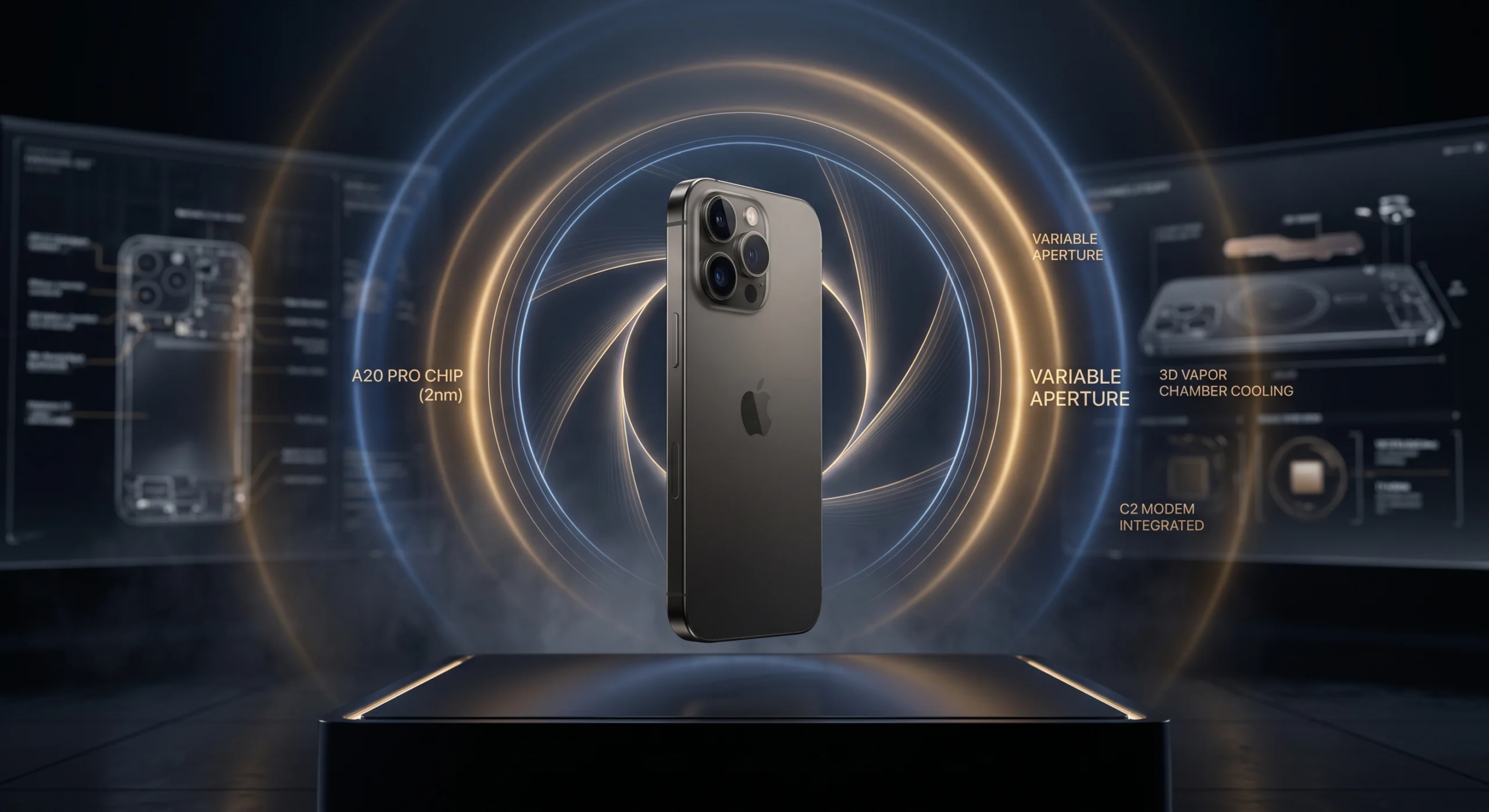
The massive hype surrounding the iPhone 18 Pro Max stems from a deliberate pivot in Apple’s engineering philosophy. After several iterative generations where annual releases felt mostly like polish rather than reinvention, the iPhone 18 Pro Max represents a major technological leap. It transitions key internal systems from off-the-shelf components to entirely in-house silicon, debuts the world’s first commercial 2-nanometer application processor, and incorporates mechanical optical engineering that was previously confined to dedicated mirrorless cameras.
Key Technical Specifications
Component
Technical Specification
Processor
Apple A20 Pro (TSMC 2nm N2 GAA architecture)
Neural Engine
16-Core 5th-Gen NPU (45 TOPS on-device compute)
Baseband Modem
Apple In-House C2 5G / Satellite Integrated Modem
Thermal Management
Micro-etched 3D Copper Vapor Chamber + Graphene Heat Spreader
Sintered Grade 5 Forged Titanium with ceramic-infused edge finish
Battery & Charging
5,100 mAh cell, 45W wired PD 3.1 fast charging, 25W MagSafe
The A20 Pro: The World’s First 2nm Silicon
The centerpiece driving the iPhone 18 Pro Max’s unprecedented performance metrics is the A20 Pro chipset, fabricated on TSMC’s bleeding-edge 2-nanometer (N2) Gate-All-Around (GAA) process.
Transistor Density & Power: Moving from FinFET transistors to nanosheet GAA architecture virtually eliminates quantum gate leakage. The chip packs roughly 33% more transistors into the same silicon footprint while reducing baseline active power draw by up to 30%.
CPU Microarchitecture: A 6-core setup comprising 2 high-performance “Typhoon” cores operating at clock speeds up to 4.3 GHz, alongside 4 ultra-efficient “Mistral” cores. This design delivers a 22% bump in single-threaded performance and roughly 35% higher multi-threaded throughput.
Pro-Class GPU Architecture: The 6-core GPU integrates dynamic hardware caching with 2nd-generation hardware-accelerated ray tracing. It delivers console-tier rasterization, sustained high frame rates in AAA gaming titles, and native spatial mesh generation without aggressive throttling.
On-Device Neural Engine: The 16-core NPU scales to 45 TOPS (trillion operations per second). By executing localized multi-modal generative models, complex dictation transcription, instant visual segmentation, and real-time audio isolation, user data remains processed on-device rather than hitting cloud endpoints.
Revolutionary Mechanical Optics: The Variable Aperture Camera
Smartphones have historically relied on fixed apertures, depending on digital post-processing and machine learning to fake optical depth. The iPhone 18 Pro Max breaks this limitation by deploying a physically motorized, multi-blade variable aperture on the primary 48MP wide sensor.
Optical Flexibility ($f/1.48$ to $f/4.0$): In low-light scenarios, the mechanical iris opens completely to $f/1.48$, letting in roughly 42% more raw photons than predecessor lenses. This slashes optical noise and nearly eliminates the need for computational Night Mode long exposures. In high-contrast daytime situations or landscape shooting, the aperture closes down to $f/4.0$, ensuring end-to-end edge sharpness, eliminating chromatic fringing, and generating genuine optical starbursts on directional light sources.
Authentic Subject Separation: Portrait mode no longer needs to aggressively synthesize artificial blur. At wide apertures, the 1-inch-equivalent optical crop produces natural shallow depth of field, rendering clean bokeh and smooth optical roll-off around complex silhouettes like hair and translucent glass.
Continuous 10x Tetraprism Telephoto: The telephoto camera features an updated folded-glass periscope design supporting genuine 10x optical zoom without software upscaling, paired with sensor-shift 3D optical image stabilization capable of 15,000 micro-adjustments per second.
Unified 48MP Sensor Array: All three rear cameras—Ultra-Wide, Wide, and Telephoto—operate on native 48MP quad-pixel sensors. This allows seamless color parity, zero color-temperature shifting when switching focal lengths, and cinematic 8K ProRes video recording at up to 60 FPS across all focal lengths.
Built-in Apple C2 Modem & Proprietary Connectivity
For years, iPhones relied on third-party modems (such as Qualcomm Snapdragon platforms) which, while capable, required separate motherboard space and dedicated power management ICs. The iPhone 18 Pro Max debuts Apple’s fully unified C2 baseband modem.
Unified Silicon Synergy: Because the C2 modem is co-designed directly alongside the A20 Pro and the radio-frequency front-end (RFFE), it shares low-latency memory pathways. This direct bus access reduces transceiver power draw by up to 35% during extended 5G cellular sessions.
Dynamic Band Aggregation: The modem introduces predictive channel shifting, analyzing signal degradation 500 milliseconds before drops occur, seamlessly routing active data packets between sub-6GHz, mmWave, and local Wi-Fi 7 networks without socket timeouts.
Direct-to-Cell Satellite 2.0: Expanding emergency satellite services, the C2 architecture allows bi-directional low-bandwidth messaging and periodic location tracking through commercial low-Earth-orbit constellations without pointing the phone manually toward the sky.
Thermal throttling has historically been the Achilles’ heel of high-performance glass-and-titanium devices. The internal chassis of the iPhone 18 Pro Max has been structurally re-engineered to resolve heat bottlenecks permanently.
Laser-Welded 3D Vapor Chamber: Replacing passive graphite sheets, Apple integrated a closed-loop, micro-wicked copper vapor chamber directly between the logic board and the forged titanium midframe. Deionized liquid inside vaporizes at the heat source (the A20 Pro and charging controller), migrates across the frame, condenses on cooler perimeter walls, and circulates back through capillary action.
Sustained Heavy Loads: In sustained workloads like 4K ProRes Log video capture, high-fidelity gaming, or long video exports, thermal throttling is delayed by upwards of 400%, maintaining peak system performance without the display dimming automatically to protect hardware components.
Display, Audio, and Exterior Refinements
Ultra-Compact Dynamic Island: By moving the flood illuminator and proximity hardware beneath the active display pixels, the visible footprint of the Dynamic Island cutout has been reduced by nearly 35%, reclaiming usable status bar real estate.
Tandem ProMotion Panel: Borrowing OLED engineering from pro-grade tablets, the panel achieves an unprecedented peak outdoor brightness of 3,500 nits while holding a steady 1,600 nits in direct sunlight without thermal panel degradation. The refresh rate dynamically scales between 1Hz for ambient Always-On display states and 144Hz for high-velocity UI navigation and responsive gaming input.
18MP Front-Facing TrueDepth Camera: The selfie sensor sees its first major resolution and focal length upgrade in years, sporting native square-pixel binning and auto-framing software to maintain framing during active multi-person calls.
The Verdict: Why the Excitement Exists
The hype around the iPhone 18 Pro Max is justified because it solves real, persistent hardware complaints rather than settling for cosmetic updates.
Between the efficiency of the 2nm A20 Pro silicon, the heat dissipation of the custom vapor chamber, the autonomy delivered by the built-in C2 modem, and the physical utility of the variable aperture optics, the phone reclaims clear leadership in hardware engineering. It is a workhorse platform tailored for users who push their smartphones to the bleeding edge of content creation, sustained performance, and battery endurance.
One thought on “iPhone 18 Pro Max: The End of Professional Cameras?”


 1






One thought on “iPhone 18 Pro Max: The End of Professional Cameras?”