

 11
11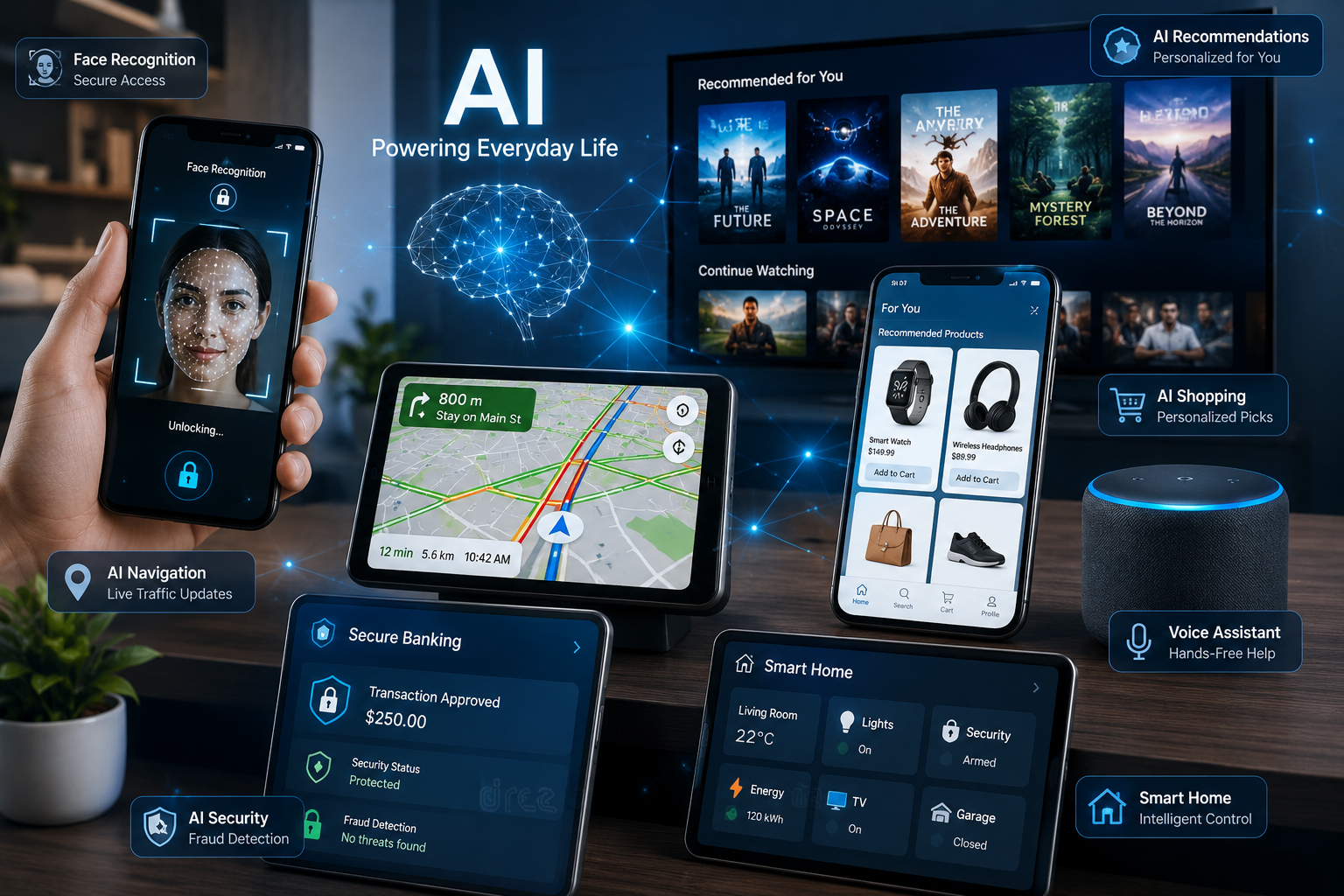
Artificial intelligence (AI) often sounds like something reserved for scientists, tech companies, or futuristic robots. However, the truth is much closer to home. AI is already part of your daily routine, whether you’re checking directions on your phone, streaming your favorite TV show, shopping online, or unlocking your smartphone with your face.
Many people assume they rarely interact with AI, yet they use it dozens of times every day without realizing it. Instead of replacing humans, today’s AI is designed to make everyday tasks faster, smarter, and more convenient.
In this guide, you’ll discover 10 real-life examples of AI you use every day, understand how each one works, and learn why artificial intelligence has become an essential part of modern life.
Artificial intelligence is already integrated into everyday technologies such as smartphones, navigation apps, streaming services, online shopping platforms, email, banking, and smart home devices. These AI-powered systems analyze data, recognize patterns, and make intelligent recommendations or decisions that help save time, improve convenience, and enhance user experiences.
Artificial intelligence refers to computer systems that can perform tasks typically requiring human intelligence. These tasks include:
Unlike traditional software that follows fixed instructions, AI continuously improves by learning from new information. This ability makes it useful across almost every industry.
The rapid growth of smartphones, cloud computing, and big data has made AI more accessible than ever before.
Today, AI helps people:
Rather than replacing daily activities, AI often works quietly in the background to improve them.
One of the easiest examples of AI is facial recognition.
When you look at your phone to unlock it, AI analyzes facial features such as:
Instead of comparing a simple photo, modern systems use advanced algorithms that make face recognition faster and more secure.
Ever wondered how Google Maps predicts traffic before you even start driving?
The answer is AI.
Navigation apps analyze millions of data points from users, traffic cameras, accidents, road closures, and historical driving patterns.
As a result, AI can:
If Google Maps redirects you because of unexpected congestion, AI has already predicted the delay before you encounter it.
Have you noticed that Netflix always seems to know what you’ll enjoy next?
That’s AI working behind the scenes.
Streaming platforms analyze:
Using this information, AI recommends movies and TV shows that closely match your interests.
Shopping websites rarely display random products.
Instead, AI studies your:
This information helps generate highly personalized product suggestions.
| Traditional Shopping | AI-Powered Shopping |
|---|---|
| Same products for everyone | Personalized recommendations |
| Manual searching | Smart suggestions |
| Generic offers | Customized discounts |
Whether you’re shopping for clothing, electronics, or groceries, AI makes online shopping more relevant and efficient.
Most people never think about spam filters until an unwanted email appears.
Fortunately, AI scans incoming emails to identify suspicious patterns, including:
Instead of relying on a simple keyword list, AI continuously learns from billions of emails to improve detection accuracy.
Without AI-powered spam filtering, inboxes would quickly become overwhelmed with unwanted and potentially harmful messages.
Virtual assistants such as Siri, Google Assistant, and Alexa use AI to understand spoken language.
When you ask:
AI processes your speech, understands your request, and responds within seconds.
Voice recognition continues to improve as these systems learn from user interactions.
Every social media platform uses AI to determine what appears in your feed.
Instead of displaying posts chronologically, AI considers:
This creates a personalized experience designed to keep content relevant.
If you frequently interact with educational posts, AI is more likely to recommend similar content in the future.
Banks process millions of transactions every day.
AI helps protect customers by identifying unusual spending behavior in real time.
For example, if your card is suddenly used in another country shortly after being used locally, AI may temporarily block the transaction and request verification.
This protection often works within seconds—much faster than manual reviews.
Smart home technology has become increasingly popular.
Devices powered by AI include:
These devices learn your habits over time.
For example, a smart thermostat may automatically adjust room temperature before you arrive home based on your routine.
Millions of students, professionals, and businesses now use AI-powered tools for everyday work.
These tools can help with:
Rather than replacing human creativity, these tools often support it by handling repetitive tasks and helping users work more efficiently.
Always review AI-generated content before publishing or sharing it. Human judgment remains essential for accuracy, tone, and context.
| Everyday Activity | Without AI | With AI |
|---|---|---|
| Navigation | Manual directions | Real-time traffic updates |
| Shopping | Generic suggestions | Personalized recommendations |
| Banking | Manual fraud checks | Instant fraud detection |
| More spam | Smarter filtering | |
| Entertainment | Time-consuming searches | Personalized content |
| Home Automation | Manual control | Intelligent automation |
AI has transformed many everyday experiences by offering:
When used responsibly, AI helps people focus on meaningful tasks instead of repetitive work.
Fact: Most people already use AI daily without needing technical knowledge.
Fact: AI automates certain tasks, but it also creates new roles and supports human productivity in many industries.
Fact: AI systems can make mistakes, which is why human oversight remains important—especially in healthcare, finance, and legal contexts.
To get the most from AI while protecting your privacy:
Yes. AI powers many services people use daily, including navigation apps, streaming platforms, smartphones, online shopping, banking, and email filtering.
Some AI features, such as offline photo recognition or on-device voice commands, can work without an internet connection. However, many AI services rely on cloud computing for more advanced capabilities.
AI can be safe when developed responsibly and used with proper security measures. Users should also protect their privacy and verify important information before making decisions.
No. AI excels at automating repetitive tasks, but human creativity, critical thinking, empathy, and ethical judgment remain difficult to replace.
Healthcare, finance, education, transportation, retail, manufacturing, entertainment, and customer service are among the industries making extensive use of AI.
Artificial intelligence is no longer a glimpse into the future—it is already woven into everyday life. From unlocking your smartphone and avoiding traffic to receiving personalized shopping recommendations and protecting your bank account from fraud, AI quietly improves many of the tasks you perform every day.
As AI continues to evolve, its role in daily life will likely expand even further. By understanding how these technologies work and using them responsibly, you can take advantage of their benefits while staying informed about privacy, accuracy, and security.
The next time you use your phone, stream a movie, or ask a voice assistant a question, you’ll know there’s a powerful AI system working behind the scenes to make your experience faster, smarter, and more convenient.




One thought on “10 Real-Life Examples of AI You Use Every Day Now”