

 11
11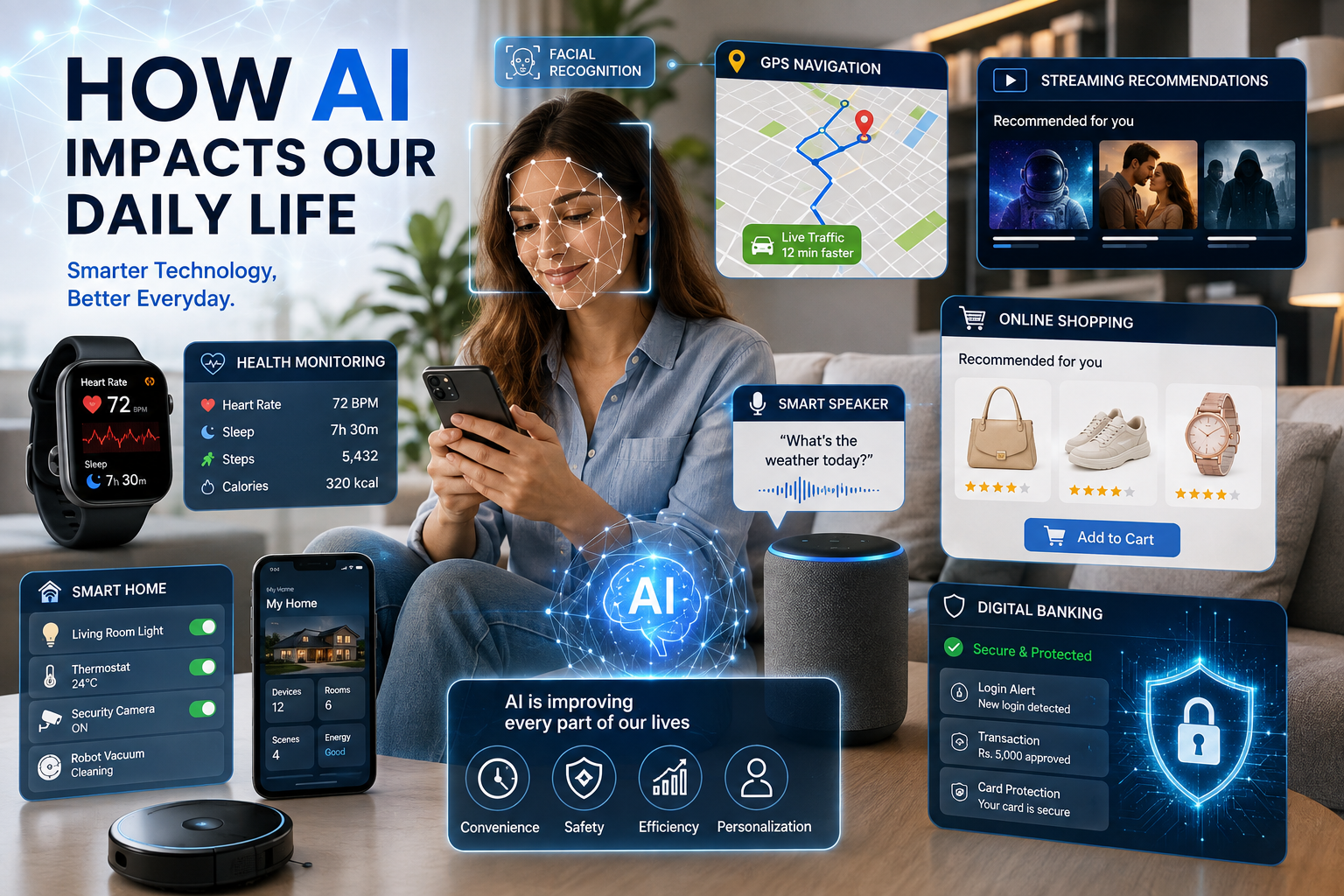
Artificial intelligence is no longer a futuristic concept reserved for science fiction movies or high-tech laboratories. Today, AI impacts our daily life in countless ways—often without us even realizing it. From unlocking smartphones with facial recognition to receiving personalized movie recommendations, AI has quietly become a part of our everyday routines.
Over the past few years, artificial intelligence has transformed how people communicate, work, shop, travel, study, and manage their health. Businesses rely on AI to improve customer service, governments use it to enhance public services, and individuals benefit from smarter digital experiences every day.
While AI offers incredible convenience and efficiency, it also raises important questions about privacy, employment, and responsible technology use. Understanding both the advantages and challenges helps us make better decisions in an increasingly AI-driven world.
Let’s explore how AI is shaping modern life and what it means for our future.
Artificial Intelligence (AI) refers to computer systems designed to perform tasks that normally require human intelligence. These tasks include:
Unlike traditional software that follows fixed instructions, AI systems improve their performance by learning from patterns and large amounts of data.
Popular AI technologies include:
Together, these technologies power many of the digital tools we use every day.
Many people think they don’t use AI. In reality, they interact with it dozens—or even hundreds—of times each day.
| Daily Activity | How AI Helps |
|---|---|
| Unlocking your phone | Facial recognition |
| Searching Google | Personalized search results |
| Watching Netflix | Content recommendations |
| Shopping online | Product suggestions |
| Using GPS | Real-time traffic optimization |
| Banking | Fraud detection |
| Spam filtering | |
| Social media | Personalized feeds |
| Smart speakers | Voice recognition |
| Online translation | Language processing |
AI has become so seamlessly integrated into technology that many users don’t even notice it.
Modern smartphones are packed with artificial intelligence.
Some common AI-powered features include:
Your phone can instantly recognize your face, making device security both faster and more convenient.
AI automatically adjusts:
This allows users to capture professional-looking photos without manual settings.
Digital assistants like Siri, Google Assistant, and Alexa understand voice commands and help users:
AI predicts the next word you are likely to type, making texting much faster.
E-commerce platforms use AI extensively to improve customer experiences.
Whenever you see:
AI is analyzing your browsing behavior, purchase history, and interests.
Benefits include:
Consumers save time while businesses increase customer satisfaction.
Social media platforms rely heavily on AI.
Every time you scroll through Facebook, Instagram, TikTok, LinkedIn, or X, AI decides which posts appear first.
AI analyzes:
This personalization keeps users engaged but also raises concerns about digital addiction and misinformation.
Streaming services have revolutionized entertainment with AI.
Instead of browsing thousands of movies, AI recommends content based on:
Examples include:
AI helps users discover content they might never have found otherwise.
Healthcare is one of the industries benefiting the most from artificial intelligence.
AI supports medical professionals by:
AI can analyze medical scans to detect diseases earlier than traditional methods.
Examples include:
Patients can:
Researchers use AI to speed up drug discovery, reducing years of research into much shorter timelines.
Students now learn differently thanks to AI.
Educational platforms provide:
Teachers also benefit by automating repetitive tasks such as grading assignments and generating lesson plans.
AI makes education more flexible and accessible for learners around the world.
Transportation has become smarter because of AI.
Examples include:
Navigation apps use AI to:
Services like Uber use AI to:
Although still developing, autonomous vehicles rely heavily on AI to recognize roads, pedestrians, traffic signs, and surrounding vehicles.
Banks process millions of transactions every day.
AI helps financial institutions by:
Many banking apps now include AI chatbots that answer customer questions 24/7.
This improves convenience while reducing operational costs.
Smart home devices have become increasingly popular.
Examples include:
These devices learn user preferences and automate daily tasks, improving comfort and energy efficiency.
Artificial intelligence is changing how people work rather than simply replacing jobs.
Employees use AI to:
Businesses gain:
Workers who learn to use AI effectively often become more productive rather than less valuable.
Many companies now provide instant support through AI chatbots.
Customers can:
Benefits include:
Human agents still handle complex cases that require empathy and critical thinking.
Artificial intelligence offers numerous advantages across different aspects of life.
Many routine tasks now happen automatically, saving valuable time.
AI handles repetitive work, allowing people to focus on creative and strategic tasks.
From music playlists to shopping recommendations, AI creates experiences tailored to individual preferences.
AI improves:
Businesses analyze massive datasets in seconds using AI-powered tools.
Despite its advantages, AI also presents important challenges.
Many AI systems collect personal data to provide personalized experiences.
Users should understand:
Protecting privacy remains a major concern.
Automation may replace certain repetitive jobs.
However, AI also creates new opportunities in:
Continuous learning is becoming increasingly important.
AI systems learn from existing data.
If the training data contains bias, AI decisions may also become unfair.
Developers must ensure:
Responsible AI development is essential.
Generative AI can produce convincing text, images, audio, and videos.
While this technology has many positive uses, it also increases the risk of:
Digital literacy is becoming an essential life skill.
To enjoy AI safely and effectively:
Responsible use maximizes the benefits while minimizing the risks.
Artificial intelligence will continue becoming more integrated into daily routines.
Future developments may include:
Rather than replacing humans entirely, AI is expected to become a collaborative tool that enhances human capabilities.
The key challenge will be ensuring innovation remains ethical, transparent, and beneficial for everyone.
AI improves everyday activities such as communication, shopping, navigation, healthcare, banking, education, entertainment, and workplace productivity through automation and intelligent decision-making.
Common examples include facial recognition, voice assistants, recommendation systems, spam filters, GPS navigation, fraud detection, smart home devices, online shopping suggestions, and AI chatbots.
AI offers many benefits, including increased efficiency, convenience, and personalization. However, it also presents challenges such as privacy concerns, misinformation, bias, and potential job displacement. Responsible development and use are essential.
AI is likely to automate repetitive tasks rather than replace every job. Many roles will evolve, and new careers related to AI development, management, cybersecurity, and digital innovation are expected to grow.
Yes. AI depends on the quality of its training data and algorithms. It can produce inaccurate or biased results, which is why human oversight remains important.
There is no doubt that AI impacts our daily life in profound ways. From the moment we unlock our smartphones in the morning until we stream a movie at night, artificial intelligence quietly powers many of the technologies we rely on every day.
Its influence continues to expand across healthcare, education, transportation, finance, entertainment, workplaces, and countless other industries. While AI delivers remarkable convenience and efficiency, it also requires thoughtful regulation, ethical development, and responsible use.
The future belongs not to those who fear artificial intelligence but to those who understand it, adapt to it, and use it wisely. By embracing AI as a tool that complements human intelligence rather than replaces it, individuals and businesses can unlock new opportunities while building a smarter, safer, and more innovative world.



One thought on “How AI Impacts Our Daily Life Now”