

 11
11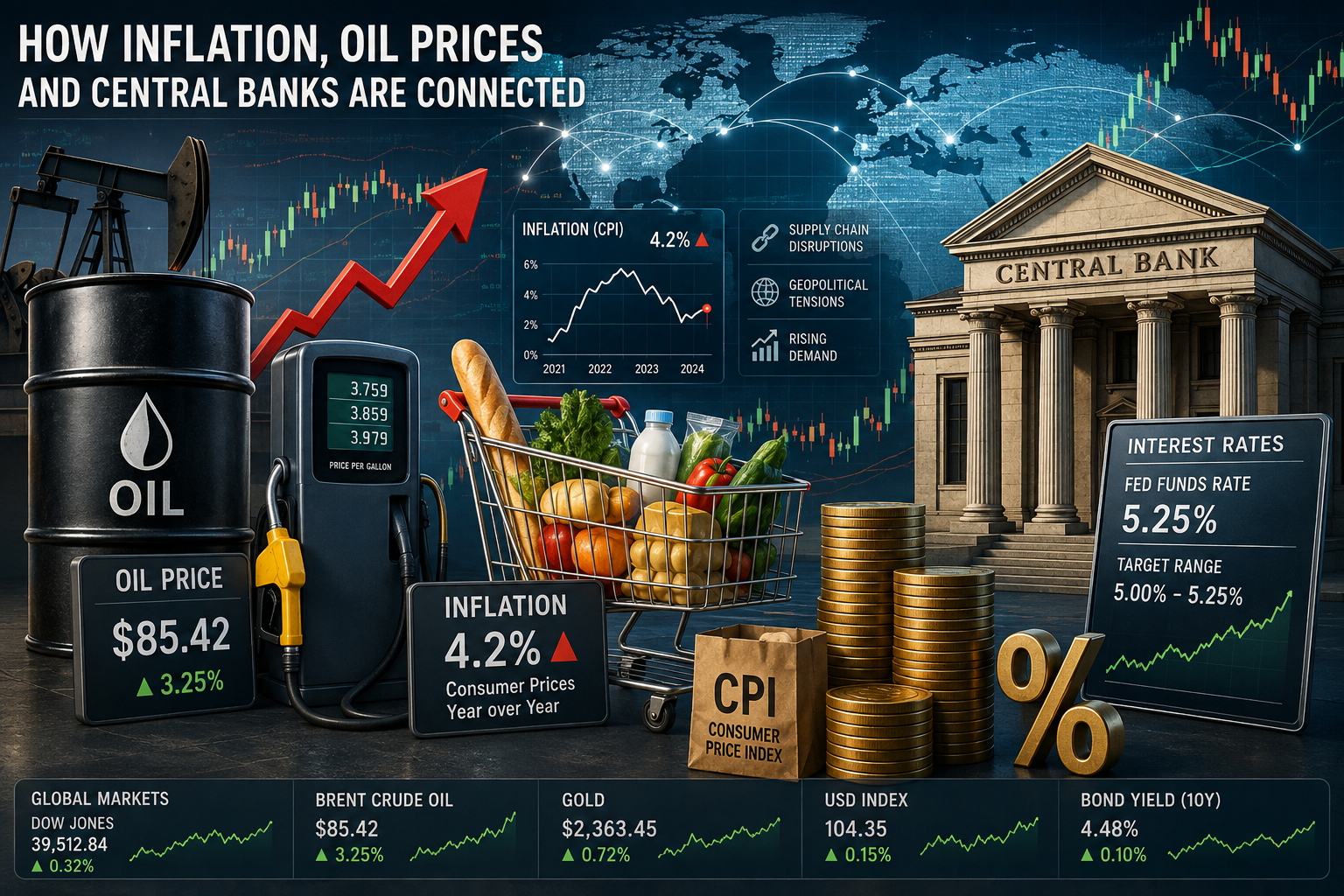
Imagine filling your car with fuel one week and paying noticeably more the next. Soon after, you realize groceries, electricity bills, and transportation costs are also rising. At the same time, headlines report that a central bank has increased interest rates to fight inflation. These events may seem unrelated, but they are deeply connected.
Understanding how inflation, oil prices, and central banks are connected helps explain why everyday expenses change, why borrowing becomes more expensive, and why financial markets react so strongly to economic news.
Oil is one of the world’s most important commodities. It powers transportation, manufacturing, agriculture, and countless industries. When oil prices rise, businesses often face higher operating costs, which can lead to higher prices for consumers. If inflation becomes persistent, central banks may step in by raising interest rates to slow economic activity and stabilize prices.
This article explains the relationship between these three powerful economic forces, why they matter, and how they affect households, businesses, investors, and the global economy.
Inflation is the rate at which the overall price of goods and services increases over time, reducing the purchasing power of money.
For example, if a loaf of bread costs $2 today but costs $2.20 next year, inflation has increased its price by 10%.
A moderate level of inflation is generally considered healthy because it reflects growing economic activity. However, rapid or prolonged inflation can reduce living standards and create economic uncertainty.
Oil affects almost every sector of the economy.
Whether products are manufactured, transported, or delivered, energy plays a critical role. Because oil is used in transportation, shipping, aviation, agriculture, plastics, and industrial production, changes in oil prices quickly ripple through global markets.
| Industry | Impact of Higher Oil Prices |
|---|---|
| Transportation | Higher fuel costs |
| Airlines | Increased operating expenses |
| Manufacturing | Rising production costs |
| Agriculture | More expensive farming and distribution |
| Retail | Higher shipping expenses |
| Logistics | Increased freight costs |
When companies spend more on energy, they often pass those costs on to consumers, contributing to inflation.
Oil prices and inflation often move together.
When crude oil becomes more expensive:
This is known as cost-push inflation, where higher production costs push prices upward across the economy.
Suppose oil prices increase by 30%.
A delivery company now spends significantly more on fuel. To maintain profits, it raises shipping charges. Retailers then increase product prices, and consumers ultimately pay more.
One increase in oil prices can therefore affect thousands of products.
Oil markets respond quickly to global developments.
Major factors include:
Wars or political instability in oil-producing regions can disrupt supply, causing prices to rise.
When major oil-producing countries reduce production, supply decreases while demand remains steady, often pushing prices higher.
Hurricanes, earthquakes, and severe weather can damage oil production facilities and refineries.
Economic growth increases demand for fuel. During strong economic periods, oil consumption usually rises.
Since oil is generally priced in U.S. dollars, changes in the dollar’s value also influence global oil prices.
A central bank manages a country’s monetary policy and works to maintain economic stability.
Its primary responsibilities include:
Examples include:
Central banks closely monitor inflation.
When inflation rises beyond their target, they often increase interest rates.
Higher interest rates make borrowing more expensive, encouraging consumers and businesses to spend less.
Lower spending reduces overall demand, helping slow inflation.
This process takes time, often several months before its full effects become visible.
Interest rates influence nearly every part of the economy.
When rates rise:
When rates fall:
Central banks carefully balance these effects to avoid triggering either excessive inflation or an economic slowdown.
The relationship between inflation, oil prices, and central banks often follows a predictable cycle.
| Stage | What Happens |
|---|---|
| Oil prices rise | Production costs increase |
| Businesses raise prices | Inflation accelerates |
| Inflation exceeds target | Central bank intervenes |
| Interest rates increase | Spending slows |
| Demand decreases | Inflation gradually eases |
| Economy stabilizes | Central bank reassesses policy |
Understanding this cycle helps explain why financial markets pay close attention to oil prices and central bank announcements.
Yes.
Although oil prices are a significant contributor to inflation, they are not the only factor.
Inflation can remain elevated because of:
Likewise, oil prices may decline while inflation remains high if these other pressures persist.
Imagine an international conflict interrupts oil exports from a major producing region.
Oil prices jump by 25%.
Fuel becomes more expensive.
Shipping companies increase transportation costs.
Supermarkets pay more to receive products.
Manufacturers experience higher production expenses.
Consumers begin paying more for groceries, clothing, electronics, and household items.
If inflation continues rising, the central bank may increase interest rates to slow spending and prevent inflation from becoming entrenched.
This chain reaction demonstrates how a single event can influence the entire economy.
Businesses often adjust their strategies when oil prices and inflation rise.
Common responses include:
Companies that adapt quickly are often better positioned during periods of economic uncertainty.
Rising inflation touches almost every household.
Consumers may notice:
Families often respond by:
Financial markets react almost instantly to inflation data and central bank decisions.
Investors monitor:
These indicators help investors anticipate future economic conditions.
Different asset classes respond differently to inflation and interest rates.
| Investment | Typical Reaction |
|---|---|
| Stocks | Mixed depending on sector |
| Bonds | Often decline when rates rise |
| Gold | Frequently gains during inflation uncertainty |
| Oil | Benefits from supply shortages |
| Real Estate | Sensitive to mortgage rates |
| Cash | Loses purchasing power during high inflation |
Diversification becomes especially important during periods of economic uncertainty.
A common misconception is that central banks directly influence oil prices.
They do not.
Oil prices are determined primarily by:
Central banks instead focus on managing the economic consequences of changing oil prices through monetary policy.
Although oil prices can trigger inflation, not every increase results in long-term inflation.
Several factors determine the outcome:
Central banks continuously analyze these variables before adjusting interest rates.
Periods of rising inflation can be challenging, but practical financial habits can help.
Small adjustments today can make a meaningful difference during periods of economic uncertainty.
Higher oil prices raise transportation, manufacturing, and production costs. Businesses often pass these additional costs to consumers, increasing the prices of goods and services.
Central banks raise interest rates to reduce borrowing and spending, helping slow inflation and maintain price stability.
Yes. Inflation can decline if consumer demand weakens, supply chains improve, or monetary policy successfully slows spending, even if oil prices remain relatively high.
Not always. Temporary price spikes may have only a limited effect if businesses absorb the costs or if demand remains weak.
Inflation reduces purchasing power, making groceries, transportation, housing, healthcare, and other everyday expenses more expensive over time.
The connection between inflation, oil prices, and central banks is one of the most important relationships in modern economics. Rising oil prices can increase production and transportation costs, contributing to inflation across many industries. In response, central banks often adjust interest rates to slow demand and maintain economic stability.
While these economic forces can seem complex, understanding how they interact makes it easier to interpret financial news, prepare for changing market conditions, and make more informed personal and business decisions. Whether you are a consumer managing household expenses, an investor monitoring markets, or a business owner planning for future costs, recognizing this relationship provides valuable insight into how the global economy operates.





One thought on “How Inflation, Oil Prices, and Central Banks Are Connected Now”