
 11
11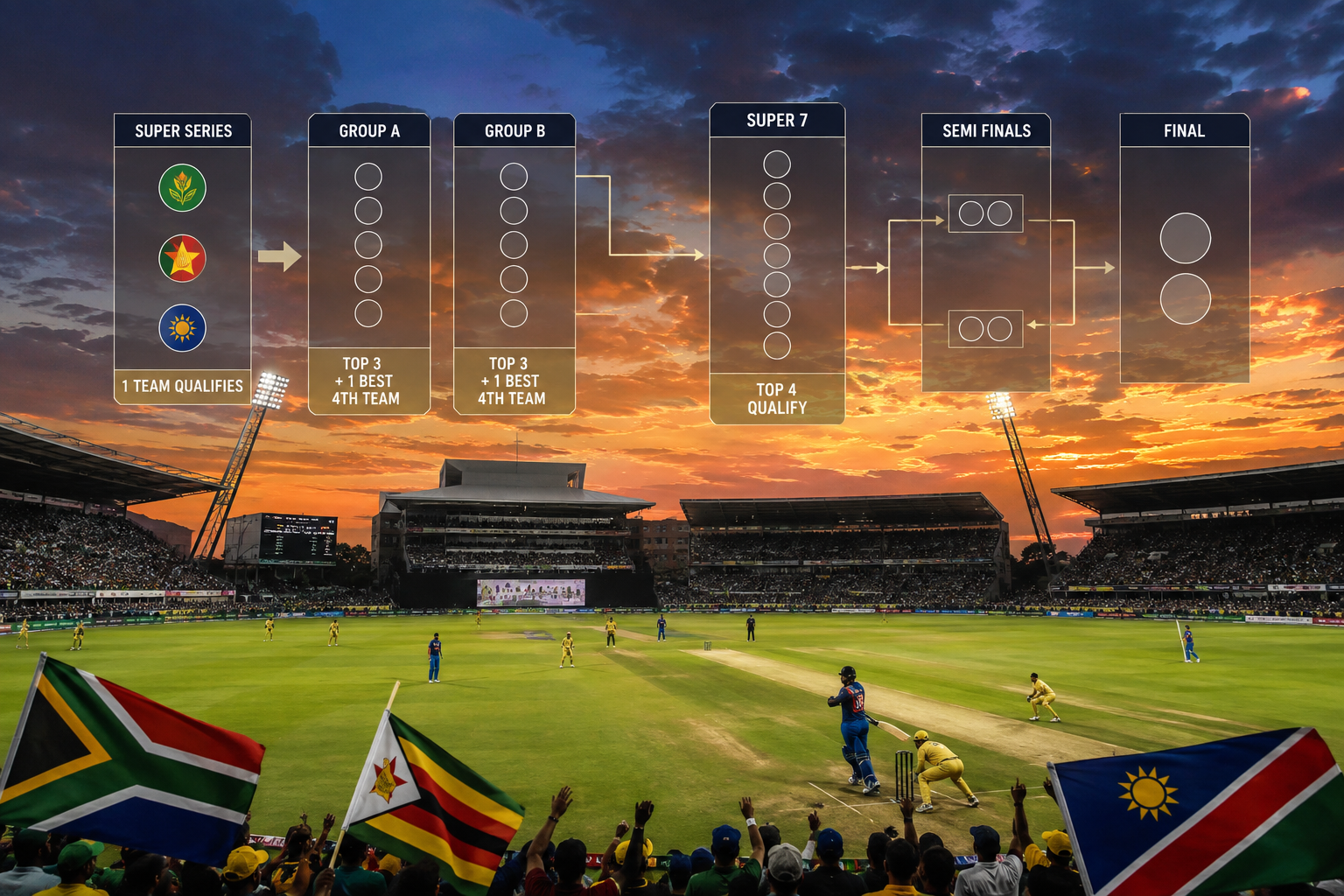
The 2027 Cricket World Cup format has become one of the biggest talking points in international cricket, and for good reason. The ICC has expanded the tournament to 14 teams while replacing the previously announced structure with a new three-stage competition designed to make more matches meaningful.
The 2027 World Cup will be hosted by South Africa, Zimbabwe and Namibia and is scheduled for October and November 2027. The tournament will still feature 14 teams, but the route from the opening match to the semi-finals has changed considerably.
The ICC says the revised 2027 Cricket World Cup format is intended to increase competitiveness, consequence and excitement throughout the tournament. However, some fans believe the new structure could make the competition more complicated than necessary.
So, why has the format divided cricket fans?
The answer lies in the balance between competitive cricket, fairness, simplicity and entertainment.
The ICC announced the revised format on July 15, 2026. Instead of moving directly into two groups of seven followed by a Super Six stage, the tournament will now begin with a Super Series involving the three lowest-ranked qualified teams.
The winner of that opening round advances to the main group stage. The remaining 12 teams then compete in two groups of six.
From there, seven teams advance to the Super 7 stage, where they play another round-robin competition. The top four teams reach the semi-finals.
The structure can be simplified like this:
| Stage | Teams | Matches/Structure | Qualification |
|---|---|---|---|
| Super Series | 3 | Round robin | Winner advances |
| Group Round | 12 | Two groups of six | 7 teams advance |
| Super 7 | 7 | Round robin | Top 4 advance |
| Semi-finals | 4 | 2 matches | Winners reach final |
| Final | 2 | 1 match | Champion crowned |
The tournament is still planned as a 14-team, 54-match World Cup, consistent with the International Cricket Council’s long-term expansion plan.
The ICC says the purpose of the new structure is to create more meaningful matches and greater consequence throughout the tournament.
That is important because a major criticism of expanded cricket tournaments is that some early matches can feel less significant when teams have many opportunities to recover from a defeat.
Under the new system, the ICC wants pressure to exist from the beginning.
The governing body specifically highlighted competitiveness, competitive standards and the overall fan experience when announcing the changes.
There is also another factor: expanding the World Cup gives more nations an opportunity to compete on cricket’s biggest stage.
That sounds positive, but it creates a difficult question.
How do you include more teams without making the tournament feel diluted?
The new format is essentially the International Cricket Council’s answer.
One of the strongest arguments in favor of the 2027 Cricket World Cup format is that it gives more matches genuine importance.
The opening Super Series is particularly interesting.
The three lowest-ranked qualified teams cannot simply enter the main tournament and settle into a long group campaign. Instead, they have to fight immediately for their place in Round 2.
That creates enormous pressure.
For emerging cricket nations, however, it can also provide an opportunity to make an early statement.
A team that performs exceptionally well in the Super Series can quickly move from being considered an outsider to becoming part of the main competition.
The ICC believes this structure can make the early stages more competitive while still giving emerging teams a pathway to the biggest tournament in the sport.
The new structure also means teams cannot afford to treat every early match casually.
Round 2 contains 30 matches, with 12 teams divided into two groups of six. The top three teams from each group advance, along with the next best-placed team across the two groups.
That seventh qualifying position could make the final group matches especially dramatic.
A team sitting fourth could still have a chance to qualify.
Another team sitting third might not be completely safe.
That uncertainty is exactly the type of scenario that can create compelling cricket.
The biggest criticism is simple:
It is complicated.
Cricket already has a reputation for complicated tournament structures, qualification systems, net run rates and points tables.
The 2027 format adds another layer.
A casual fan now has to understand:
For experienced cricket followers, this may not be a major problem.
For casual viewers, however, it could make the tournament harder to follow.
A World Cup should ideally be easy to understand.
When someone asks, “What does my team need to do to qualify?”, the answer should not require a spreadsheet.
That is one of the biggest challenges facing the new format.
The Super Series is perhaps the most unusual element of the 2027 World Cup.
Three teams will compete in a round-robin competition, with only the winner moving into the next stage.
From a sporting perspective, this creates immediate pressure.
But there is an obvious concern.
Imagine preparing for the biggest tournament in your country’s history and discovering that your entire World Cup campaign could effectively depend on two matches.
One bad day with the bat, one dropped catch or one exceptional performance from an opponent could dramatically change everything.
Supporters of the system would argue that World Cups are supposed to involve pressure.
Critics could respond that qualification for the main tournament should not feel like a mini-knockout competition after teams have already earned their World Cup place.
That tension will likely remain one of the major talking points as the tournament approaches.
There is another side to the debate that deserves attention.
The new structure could produce more high-pressure cricket, especially during the second and third stages.
In Round 2, seven teams qualify from 12.
That means the battle for the final qualification place could become extremely important.
Then comes the Super 7.
Every team plays every other team in that stage, producing 21 matches. The top four reach the semi-finals.
This could create an excellent balance between league cricket and knockout pressure.
Instead of reaching a Super Six stage where only a few games determine the finalists, teams will have to perform consistently against the other Super 7 sides.
That could help identify the genuinely strongest teams.
The Super 7 is arguably the most exciting part of the revised structure.
Seven teams will play a round-robin competition, meaning every team faces six opponents.
The top four then qualify for the semi-finals.
The semi-final match ups are also clearly defined:
That creates an incentive to finish as high as possible.
Finishing first is not just about bragging rights. It gives a team the opportunity to face the fourth-placed side instead of the third-placed team.
Therefore, the Super 7 could create meaningful competition right until the final league matches.
This is where the debate becomes more complicated.
A tournament format can be exciting without necessarily being perfect.
The biggest fairness question concerns the different routes teams take through the tournament.
The three lowest-ranked qualified teams begin in the Super Series, while the other 11 teams have different paths into Round 2.
That creates a difference in workload and pressure.
However, the ICC’s argument is that these teams enter the Super Series because of their ranking position among the qualified sides.
In other words, the system is designed to reward stronger qualification performances while still providing the lowest-ranked teams with a route into the main competition.
Whether fans consider that fair will depend largely on how competitive the Super Series turns out to be.
The revised system is particularly interesting because it replaces a format that had already been announced.
The earlier plan called for two groups of seven, followed by a Super Six stage. The International Cricket Council’s new structure replaces that with the Super Series, two groups of six, and a Super 7 stage.
That change is one reason the 2027 Cricket World Cup format has attracted so much attention.
Fans who had already become familiar with the original structure now have to learn a completely different tournament pathway.
It also shows how tournament design continues to evolve as the ICC tries to balance expansion with competitive quality.
Expanding the World Cup to 14 teams is a positive development for global cricket.
More countries get the chance to compete.
More players experience elite international cricket.
More fans have a reason to follow the tournament.
However, expansion also creates a structural challenge.
If every team plays too many matches, the tournament can become unnecessarily long.
If teams play too few matches, one poor performance can have too much influence.
The ICC is attempting to solve that problem by creating several stages with different levels of pressure.
The result is ambitious, but it is not simple.
Potentially, yes.
The pathway to the 2027 World Cup already includes qualification competitions such as Cricket World Cup League 2 and the Challenge League, giving Associate and developing teams routes toward the global tournament.
The new World Cup format continues that broader effort to create opportunities beyond cricket’s traditional powerhouses.
For emerging nations, reaching the World Cup itself is a major achievement.
Performing well enough to escape the Super Series could become an even bigger milestone.
If one of those teams manages to progress deep into the tournament, the format could receive a very different reception.
For major cricketing nations such as India and Pakistan, the new structure could create a different kind of pressure.
Fans will naturally focus on high-profile matches, but the bigger objective is consistent progression through every stage.
A strong team cannot afford to rely entirely on one blockbuster match.
The route to the final requires sustained performance.
That could make the 2027 World Cup particularly interesting for teams that traditionally dominate global tournaments.
For fans, it also means qualification scenarios could become as exciting as individual matches.
There is no definitive answer yet.
The format looks complicated on paper, but tournament formats are ultimately judged by what happens on the field.
If the Super Series produces close matches, if the group stage creates dramatic qualification battles, and if the Super 7 produces a tight race for the top four, fans may quickly embrace the system.
If the opposite happens, criticism will grow.
The first few weeks will therefore be crucial.
A successful tournament format should make fans care about games that might otherwise seem insignificant.
That is the real test for the 2027 Cricket World Cup format.
As the World Cup approaches, several questions will become increasingly important:
Following these developments will make the tournament much easier to understand once the action begins.
The 2027 Cricket World Cup is scheduled to take place in October and November 2027 in South Africa, Zimbabwe and Namibia. The tournament will feature 14 teams.
The competition begins with a three-team Super Series. The winner advances to Round 2, where 12 teams compete in two groups of six. Seven teams then advance to the Super 7, followed by semi-finals and the final.
The tournament will feature 14 teams.
The Super 7 is a seven-team round-robin stage. Each team plays six matches, and the top four advance to the semi-finals.
The ICC says the changes are designed to increase competitiveness, create greater consequence throughout the tournament and improve the experience for players and fans.
That remains a matter of debate. The new structure could create more meaningful matches, but its complexity may make it harder for casual fans to follow. Its ultimate success will depend on how competitive the tournament becomes.
The 2027 Cricket World Cup format is ambitious, complicated, and designed to create pressure from the opening match.
That combination explains why fans are divided.
Supporters see a tournament where more games matter, emerging teams get opportunities, and qualification battles can become dramatic. Critics see a structure that may require too much explanation and could make a traditionally straightforward global tournament harder to follow.
Neither side is necessarily wrong.
The real verdict will come in 2027.
If the Super Series delivers close cricket, the group stage creates genuine uncertainty, and the Super 7 produces a thrilling race for the semi-finals, fans may look back at the format as a smart evolution of the World Cup.
But if the structure creates confusion without adding meaningful competition, criticism will only grow.
For now, one thing is certain: the 2027 Cricket World Cup will not follow the format many fans originally expected. The new structure has changed the road to the trophy, and that alone makes it one of the most fascinating stories to follow before the first ball is bowled.