

 11
11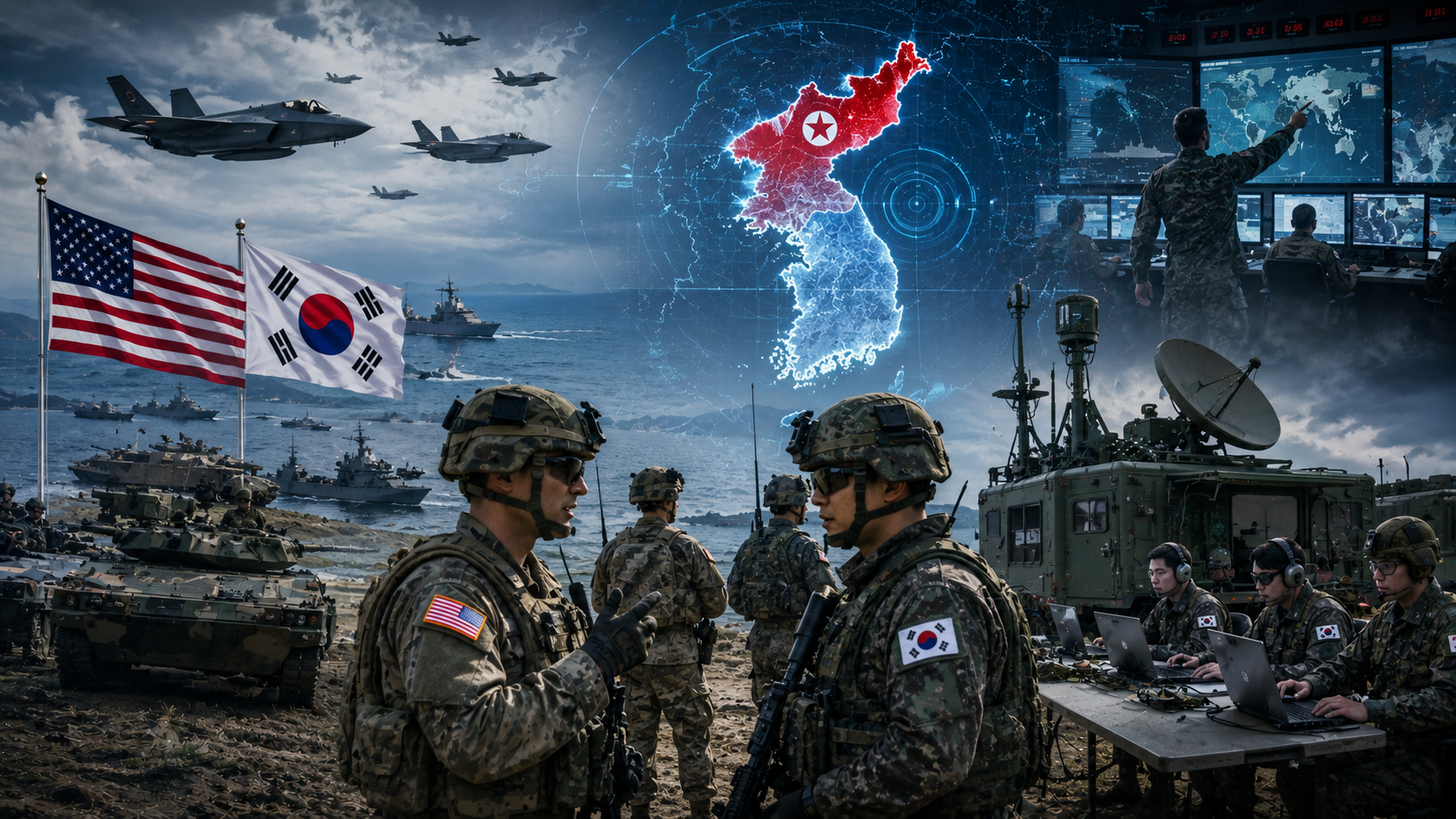
The US-South Korea military alliance is one of the most important security partnerships in East Asia. For more than seven decades, Washington and Seoul have built a defense relationship designed to deter North Korea, strengthen military readiness, and ensure that both countries can respond quickly if a major security crisis develops on the Korean Peninsula.
One of the clearest examples of this cooperation is Ulchi Freedom Shield (UFS), the annual joint exercise involving U.S. and South Korean forces. The exercise is more than a large military demonstration. It is an opportunity for commanders, troops, government agencies, and allied organizations to test how they would respond to a rapidly changing crisis.
That makes military exercises an important part of the alliance.
At a time when North Korea continues to develop its missile and nuclear capabilities, the ability of U.S. and South Korean forces to communicate, coordinate, and operate together remains a central part of regional deterrence.
However, the alliance is also evolving. Questions about the cost of military exercises, burden-sharing, Washington’s global military commitments, and diplomacy with North Korea have created a debate over how the alliance should maintain readiness while reducing unnecessary tensions.
Understanding Ulchi Freedom Shield and U.S.-South Korea military readiness therefore requires looking beyond the exercises themselves. The bigger issue is how two allies maintain credible deterrence in an increasingly complicated security environment.
The US-South Korea military alliance was established after the Korean War through the 1953 Mutual Defense Treaty.
The basic purpose is straightforward: the United States and South Korea cooperate to help protect South Korea from external threats, particularly from North Korea.
Over the decades, however, the relationship has become much broader.
It now includes:
South Korea has also developed one of Asia’s most capable conventional militaries, meaning the alliance is no longer simply a relationship in which the United States provides security while South Korea depends entirely on American forces.
Instead, the two militaries operate as increasingly sophisticated partners.
The Korean Peninsula remains one of the world’s most heavily militarized regions.
North Korea possesses ballistic missiles, a large conventional military, cyber capabilities, and a nuclear weapons program. These capabilities create a security environment in which even a relatively small crisis could escalate quickly.
For Seoul, the proximity of North Korean forces makes readiness particularly important.
For Washington, maintaining the alliance demonstrates that the United States remains committed to security partnerships in the Indo-Pacific.
Consequently, the alliance has importance beyond the Korean Peninsula.
It is also a major component of the wider U.S. security architecture in Asia.
Ulchi Freedom Shield is a major annual U.S.-South Korean military exercise designed to strengthen combined readiness.
The exercise combines military training with command-and-control activities and broader government crisis-response procedures.
Rather than focusing on a single battlefield scenario, the exercise is intended to test how the alliance would respond to a complex emergency.
Training can involve:
This broad structure reflects the reality of modern warfare.
A future crisis would not necessarily begin with tanks crossing a border. It could involve missile launches, cyberattacks, attacks on communications systems, misinformation campaigns, disruptions to infrastructure, and rapid military movements occurring simultaneously.
The purpose of exercises such as UFS is to make sure the alliance is prepared for that kind of uncertainty.
Military readiness is often misunderstood as simply having large numbers of soldiers and weapons.
In reality, readiness also depends on whether different forces can work together effectively.
Imagine that American and South Korean forces have advanced aircraft, missile systems, ships, communications equipment, and intelligence capabilities.
If those systems cannot communicate effectively during a crisis, their combined strength can be significantly reduced.
Joint exercises help identify these weaknesses before an actual emergency.
A military can possess sophisticated equipment and still face serious operational problems.
Readiness includes:
These areas cannot be mastered entirely through manuals.
They require practice.
That is why military exercises remain important even when no conflict is taking place.
One of the biggest advantages of UFS is that it creates an environment where both militaries can practice operating as a combined force.
The exercise gives commanders opportunities to test procedures and identify gaps.
For example, a simulated missile crisis could require several organizations to respond almost simultaneously.
South Korean air-defense units may need to detect and track a threat. U.S. forces may need to provide additional intelligence. Commanders could then coordinate aircraft, missile-defense systems, naval assets, and political decision-making.
The exercise allows these interactions to be tested under controlled conditions.
Every military exercise generates lessons.
Commanders can discover that a communication process is too slow. Units can identify logistical problems. Different organizations can discover that they interpret operational instructions differently.
These problems are much easier to fix during training than during an actual war.
Therefore, the real value of UFS is not simply the number of troops participating.
Its value lies in improving the ability of the alliance to function under pressure.
North Korea remains the central reason for maintaining strong military readiness on the Korean Peninsula.
Pyongyang has invested heavily in missile development and nuclear capabilities. Its growing ability to threaten South Korea, Japan, U.S. forces in the region, and potentially more distant targets has changed the strategic environment.
North Korea also regularly criticizes U.S.-South Korean military exercises, describing them as preparations for invasion.
Washington and Seoul, however, have traditionally argued that the exercises are defensive and necessary to maintain readiness.
This disagreement creates a difficult strategic balance.
The alliance must answer two competing questions:
How can it remain strong enough to deter North Korea without creating unnecessary escalation?
A weaker military posture could potentially encourage North Korea to believe that the alliance is losing cohesion.
But extremely large or highly visible exercises can also be used by Pyongyang as justification for its own military activities.
This is one reason military exercises have become closely connected to diplomacy.
The challenge is not simply deciding whether to exercise.
It is deciding how, when, and at what scale to exercise.
The debate over the scale of exercises does not necessarily have to be a choice between enormous drills and no training at all.
The United States and South Korea can use different forms of training to maintain capabilities.
| Training approach | Main advantage | Potential limitation |
|---|---|---|
| Large combined exercises | Tests broad alliance capabilities | More expensive and politically visible |
| Smaller field exercises | Maintains practical skills | Covers fewer scenarios |
| Computer simulations | Tests command decisions | Cannot fully replicate battlefield conditions |
| Specialized drills | Focuses on specific weaknesses | Less comprehensive |
| Rotational training | Provides flexibility | Requires careful scheduling |
| Civil-military exercises | Tests wider crisis response | Can be complex to coordinate |
A balanced approach could combine several of these methods.
For example, smaller field exercises could maintain tactical readiness while computer simulations test large-scale command procedures.
That would allow the alliance to preserve important capabilities while potentially reducing some of the financial and political costs associated with massive exercises.
One of the most important concepts in the US-South Korea military alliance is interoperability.
In simple terms, interoperability means that two militaries can operate effectively together.
That requires more than sharing a common objective.
It involves compatible communications systems, procedures, terminology, intelligence-sharing mechanisms, command structures, and operational planning.
Consider a hypothetical missile warning.
A detection system identifies a launch. Information must move quickly to commanders. The threat must be assessed. Air-defense systems need to receive appropriate information. Aircraft or other assets may need to be repositioned.
A delay at any point can reduce the effectiveness of the response.
Regular joint exercises help both sides become familiar with these processes.
The presence of U.S. forces in South Korea is another major component of deterrence.
American forces provide additional capabilities, including advanced aircraft, intelligence resources, logistics, command capabilities, and other military assets.
Their presence also carries a political message.
It demonstrates that the United States has a direct security interest in the Korean Peninsula.
For South Korea, this provides an additional layer of deterrence.
For North Korea, the presence of American forces creates uncertainty about the potential scale of a U.S. response to aggression.
This is often referred to as extended deterrence.
The alliance is not a one-way arrangement.
South Korea has built a highly capable military of its own and continues to invest in advanced defense technologies.
Its military capabilities include modern fighter aircraft, naval vessels, missile systems, surveillance technologies, and sophisticated command structures.
This development allows Seoul to take greater responsibility for its own defense while continuing to benefit from American support.
That is particularly important as discussions about alliance burden-sharing continue.
U.S. policymakers have repeatedly argued that American allies should contribute significantly to their own defense.
South Korea has increased its defense capabilities over many years, but disagreements over how costs should be divided can still affect political discussions between Washington and Seoul.
The question is increasingly broader than simply who pays for military exercises.
It also concerns how responsibilities should be divided across the alliance.
A stronger South Korean military can reduce some pressure on U.S. forces, while American capabilities can provide strategic assets that would be difficult for South Korea to reproduce independently.
The two sides therefore have strong incentives to maintain cooperation.
Any significant change to joint military exercises can have consequences beyond training schedules.
Allies watch these decisions carefully because exercises can serve as indicators of strategic commitment.
If exercises become smaller, less frequent, or less complex, North Korea could interpret the change as a reduction in American commitment.
South Korean policymakers could also question whether the United States remains prepared to respond quickly to a crisis.
At the same time, a reduction could potentially create diplomatic space.
If Pyongyang considers large-scale exercises provocative, modifying their size or format could make dialogue easier.
The result depends heavily on how the change is communicated and what other elements of the alliance remain intact.
This is one of the most important concerns surrounding changes to U.S.-South Korean military training.
Deterrence depends partly on the perception that an opponent will face a strong and coordinated response.
If training declines significantly, an adversary could conclude that the alliance is less prepared.
However, exercise size alone does not determine deterrence.
Other factors matter, including:
Therefore, a smaller exercise does not automatically mean a weaker alliance.
The real concern would arise if reduced training became part of a broader decline in operational readiness.
Military readiness and diplomacy are sometimes presented as opposites.
They do not have to be.
A strong alliance can maintain sufficient readiness while pursuing diplomatic engagement.
In fact, credible military preparedness can sometimes support diplomacy because it reduces the incentive for an opponent to test the alliance through coercion.
At the same time, diplomacy can reduce the likelihood that military capabilities will ever need to be used.
The ideal outcome is therefore not permanent military confrontation.
It is strong deterrence combined with meaningful diplomacy.
The alliance is likely to face several major challenges in the coming years.
North Korea’s nuclear and missile capabilities will remain the central security concern.
Washington is managing challenges in Europe, the Middle East, and the Indo-Pacific simultaneously. That means U.S. military resources must be allocated carefully.
The financial responsibilities associated with maintaining U.S. forces and joint exercises will remain an important political issue.
Artificial intelligence, drones, cyberwarfare, satellites, precision missiles, and electronic warfare are changing military planning.
Any renewed engagement between Washington, Seoul, and Pyongyang could influence the size and nature of future military exercises.
These factors mean the alliance will need to remain flexible.
The future US-South Korea military alliance may not depend entirely on increasingly large exercises.
Instead, it could combine multiple layers of readiness.
A modern model could include:
This approach could help maintain operational readiness without relying on one massive annual event as the primary measure of alliance strength.
The US-South Korea military alliance is a longstanding defense partnership established after the Korean War. It is designed to deter aggression and strengthen the security of South Korea and the wider Korean Peninsula.
Ulchi Freedom Shield is a major annual joint U.S.-South Korean military exercise. It tests combined command, operational coordination, field capabilities, and crisis-response procedures.
They help both militaries practice operating together. Exercises can identify weaknesses in communications, logistics, planning, command structures, and interoperability before an actual crisis occurs.
The United States and South Korea describe their alliance exercises as defensive and focused on maintaining readiness. North Korea, however, routinely views such exercises as provocative.
It could if reductions significantly affect readiness or create doubts about U.S. commitment. However, smaller exercises can still preserve important capabilities if combined with other forms of training and strong operational cooperation.
Pyongyang views the exercises as a potential threat to its security and has repeatedly criticized them. Washington and Seoul argue that the exercises are necessary to deter aggression and prepare for potential crises.
No. South Korea has a highly capable military and significant defense-industrial and technological capabilities. The alliance combines South Korean conventional strength with American military, intelligence, strategic, and logistical capabilities.
Extended deterrence refers to the United States using its broader military capabilities and security commitments to help deter attacks against an ally such as South Korea.
The US-South Korea military alliance remains a central pillar of security in East Asia, but maintaining it requires more than simply conducting large military exercises every year.
Ulchi Freedom Shield matters because readiness is built through practice. American and South Korean forces need to know how to communicate, coordinate, share information, manage logistics, and respond together when a crisis develops.
At the same time, the alliance operates in a complicated political environment.
North Korea’s nuclear and missile programs continue to create serious security challenges. Washington must balance its commitments across multiple regions. Seoul must maintain credible deterrence while protecting its own strategic interests. And both governments must consider whether military exercises can be structured in ways that preserve readiness without unnecessarily increasing tensions.
The future of the alliance will therefore depend on finding the right balance between military preparedness, technological modernization, burden-sharing, and diplomacy.
Reducing the size or frequency of an exercise does not automatically weaken an alliance. But maintaining credible deterrence requires that any changes preserve the ability of U.S. and South Korean forces to operate together when it matters most.
Ultimately, the strength of the alliance will be measured not simply by the number of troops participating in an exercise, but by whether Washington and Seoul can continue to demonstrate unity, readiness, interoperability, and strategic commitment in an increasingly uncertain region.


One thought on “US-South Korea Military Alliance: Trump want support”