

 11
11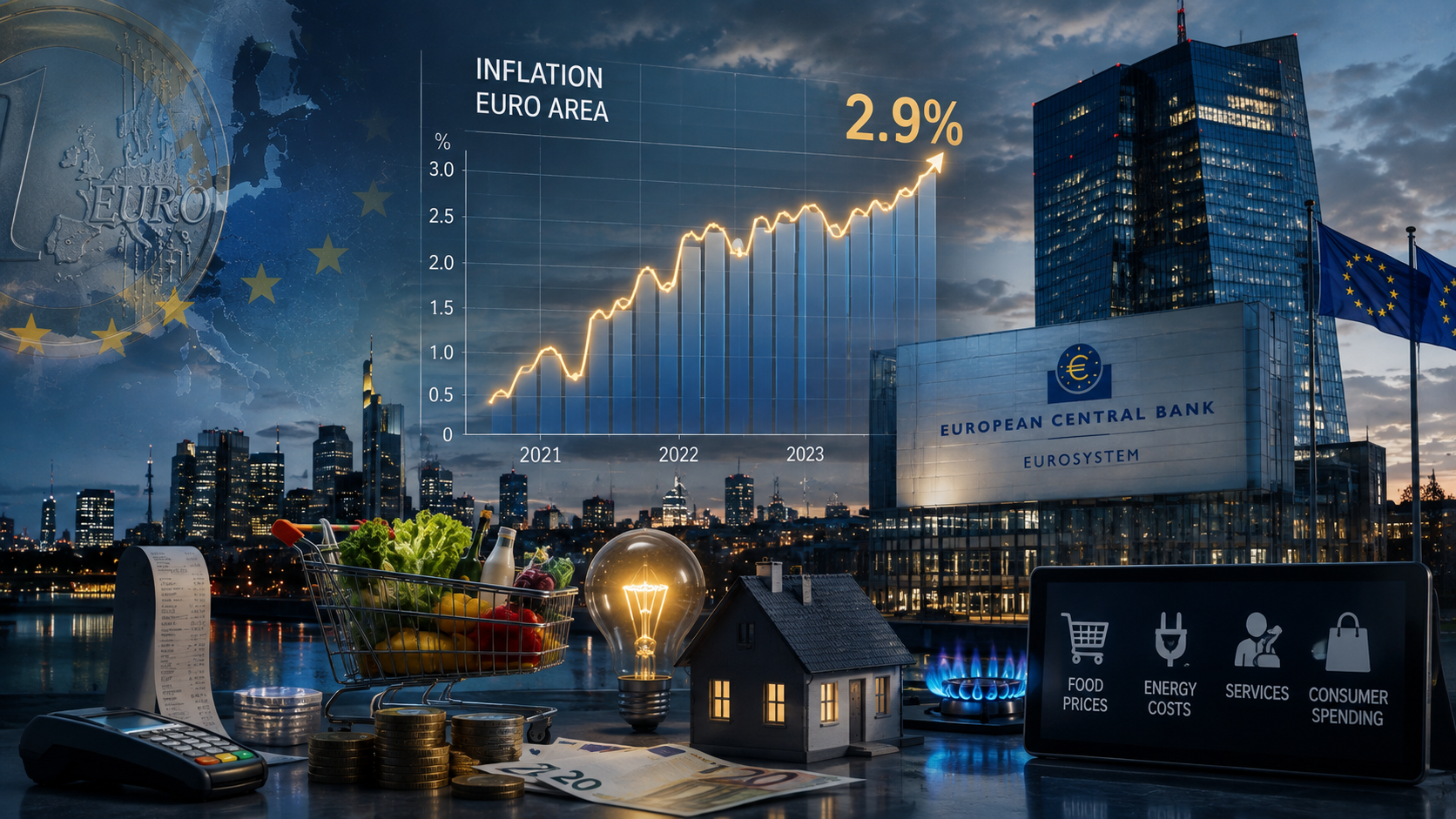
Inflation in the euro area ended 2023 with a small but noticeable increase. The annual inflation rate reached 2.9% in December, up from 2.4% in November, according to Eurostat. A year earlier, the rate had been 9.2%, making the latest figure look dramatically better than the inflation shock Europe experienced during 2022.
At first glance, a move from 2.4% to 2.9% might seem like a setback. And in one sense, it is. Prices were still rising faster at the end of the year than they had a month earlier.
But the December figure needs some context.
Inflation was nowhere near the levels seen during the energy crisis, and the composition of price pressures had changed considerably. Services and food were still adding to inflation, while energy was making a negative contribution to the overall rate.
That distinction matters because the headline number tells only part of the story.
Eurostat’s final data showed that annual inflation in the euro area increased to 2.9% in December 2023, compared with 2.4% in November. The European Union’s annual inflation rate also increased, reaching 3.4% from 3.1% in November.
The change was relatively modest compared with the huge swings seen earlier in the inflation crisis.
For comparison, euro area inflation had been running at 9.2% in December 2022. By December 2023, it had fallen to less than one-third of that level.
That is why the December increase should not automatically be interpreted as Europe returning to the inflation crisis of the previous year.
The direction of travel had changed.
The question entering 2024 was whether inflation would continue moving gradually toward the European Central Bank’s target or remain stubbornly above it.
The headline increase had several moving parts.
According to Eurostat, services made the largest contribution to the annual euro area inflation rate in December, adding 1.74 percentage points. Food, alcohol and tobacco contributed 1.21 percentage points, while non-energy industrial goods contributed 0.66 percentage points. Energy, meanwhile, made a negative contribution of 0.68 percentage points.
That tells an interesting story.
The energy shock that had dominated Europe’s inflation problem was no longer pushing the headline rate upward in the same way. Instead, services and food remained important sources of price pressure.
This is one reason economists pay attention to more than the headline inflation number.
If energy prices fall, inflation can slow quickly. But if service prices continue rising because of wages, rents and other costs, inflation can prove more persistent.
Services accounted for the largest contribution to euro area inflation in December.
The category includes a wide range of everyday expenses, from restaurants and hotels to transport, insurance and other services.
Services inflation can be particularly difficult to bring down because it is often linked to domestic economic conditions rather than global commodity prices.
When wages rise and businesses face higher labor costs, service providers may pass some of those costs on to customers.
That does not mean higher wages are necessarily a problem.
For households, stronger wages can provide important protection against the loss of purchasing power caused by earlier inflation. The challenge for policymakers is finding a point where wages and prices can adjust without creating a self-reinforcing cycle.
Food prices were another important part of the December inflation picture.
Eurostat recorded a 3.2% annual increase for food, alcohol and tobacco in the euro area, although this was considerably lower than the rates seen during the worst part of the inflation shock.
For households, however, food inflation can feel more painful than the headline figure suggests.
People buy groceries regularly. They see the prices of bread, milk, meat, vegetables and other essentials repeatedly, which makes changes more noticeable than price movements in less frequently purchased goods.
There is also an important difference between inflation slowing and prices falling.
If food inflation falls from 10% to 3%, prices are still increasing. They are simply increasing more slowly.
That distinction is easy to miss when looking only at the annual inflation rate.
One of the most important developments was the contribution from energy.
Energy made a negative contribution of 0.68 percentage points to the euro area’s annual inflation rate in December 2023.
This was a significant change from the energy-driven inflation pressures that had shaken Europe in 2022.
The energy shock had affected households and businesses far beyond their direct electricity and heating bills. Higher energy costs also fed into transportation, manufacturing, agriculture, food production and other parts of the economy.
When those pressures eased, the impact gradually spread through the broader inflation picture.
But that relief came with a warning.
Energy prices can move quickly in response to geopolitical developments, supply disruptions and changes in global demand. A calmer energy market can help inflation fall, but policymakers cannot assume that the same conditions will continue indefinitely.
The December figure was encouraging when viewed against the previous year’s numbers.
Still, 2.9% was above the European Central Bank’s 2% inflation target.
That meant the inflation problem was becoming smaller, but it had not disappeared.
This was particularly important for the ECB because monetary policy works with a delay. Interest-rate decisions affect borrowing, investment, housing and consumer spending over time rather than immediately.
The central bank therefore had to consider where inflation was heading rather than simply reacting to one month’s data.
That made the underlying components especially important.
If falling energy prices were doing most of the work while services inflation remained relatively strong, policymakers could not simply assume that inflation would automatically return to 2%.
Inflation was far from uniform across Europe.
Eurostat reported that the lowest annual inflation rates in December 2023 were recorded in Denmark at 0.4%, Italy and Belgium at 0.5% each. At the other end of the scale, Czechia recorded 7.6%, Romania 7.0% and Slovakia 6.6%.
That gap is significant.
It shows why the phrase “euro area inflation” can sometimes hide very different experiences at the national level.
A household in Italy was facing a very different inflation environment from one in Czechia, even though both were part of the broader European economy.
| Country | Annual inflation |
|---|---|
| Denmark | 0.4% |
| Italy | 0.5% |
| Belgium | 0.5% |
| Latvia | 0.9% |
| Germany | 3.8% |
| France | 4.1% |
| Spain | 3.3% |
| Slovakia | 6.6% |
| Romania | 7.0% |
| Czechia | 7.6% |
Source: Eurostat.
These differences can come from several factors, including energy exposure, government measures, food prices, domestic demand, and the way inflation shocks move through individual economies.
For consumers, an inflation rate of 2.9% does not mean that everything became 2.9% more expensive.
It is an average measure covering a broad basket of goods and services.
Some prices may have increased much faster. Others may have stayed relatively stable or even declined.
This is why people sometimes feel that their personal inflation rate is higher than the official figure.
A household that spends a large share of its income on food, rent, heating or transportation may experience a different cost increase from a household with a completely different spending pattern.
There is another issue, too.
The prices that rose sharply during the earlier inflation crisis do not automatically return to their old levels when inflation falls.
If an item increased from €10 to €12 during a period of high inflation, and inflation later slows, the item might remain around €12. It simply stops becoming more expensive as quickly.
That is why lower inflation does not necessarily mean lower prices.
It means prices are rising more slowly.
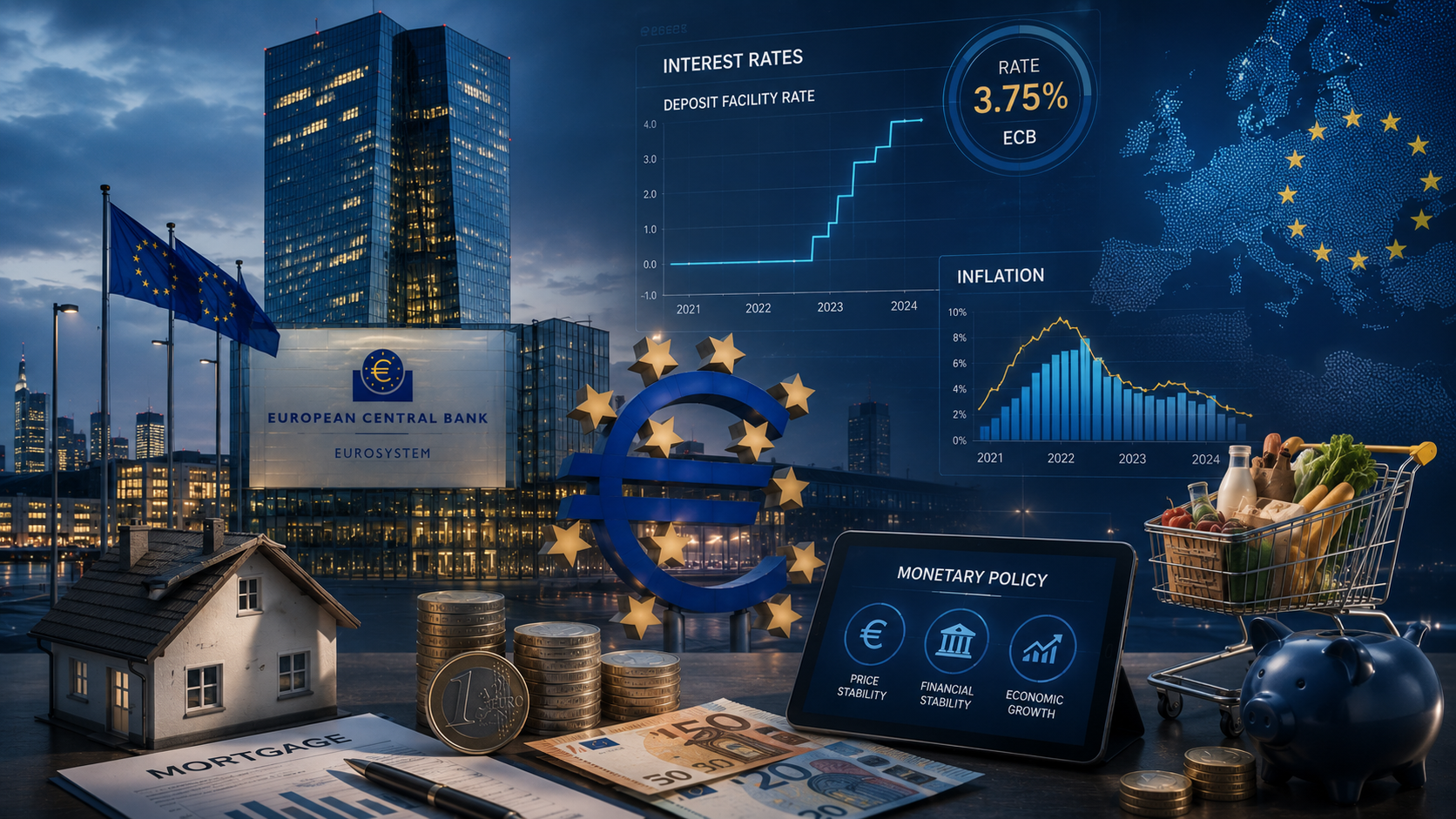
The December inflation figure was closely connected to the European Central Bank’s policy dilemma.
Interest rates had been raised aggressively during the inflation fight. By the end of 2023, the ECB had to balance two competing risks.
One was the risk of keeping monetary policy too tight for too long.
Higher borrowing costs can weaken consumer spending, investment and housing activity.
The other was the risk of easing policy too early.
If inflation remained above target, premature rate cuts could potentially make it harder to bring price growth under control.
That is why one monthly inflation figure was unlikely to determine the ECB’s next move by itself.
The broader trend mattered more.
The underlying inflation picture was also important.
Eurostat’s December data showed that inflation excluding energy was 2.5%, while inflation excluding energy and unprocessed food was 2.4%. The narrower measure excluding energy, food, alcohol and tobacco stood at 3.4%.
These measures help policymakers look beyond volatile components.
Energy prices can move sharply from month to month. Food prices can also be affected by weather, harvests and global commodity markets.
Core measures are not perfect, but they can provide a better sense of how persistent domestic price pressures are.
And in December 2023, those underlying pressures had not completely disappeared.
European Central Bank Interest Rates
The final inflation reading of 2023 offered a mixed message.
On one hand, Europe had made enormous progress compared with the inflation shock of 2022.
On the other, inflation was still above the ECB’s target, and some components remained stubborn.
That left several questions hanging over the European economy as 2024 began:
None of these questions could be answered by the 2.9% figure alone.
But the figure helped establish the starting point for the year ahead.
For households and businesses, inflation data can feel abstract until it reaches the cost of borrowing.
When inflation remains elevated, central banks generally face greater pressure to maintain restrictive monetary policy.
That can affect:
The relationship is not immediate, but it matters.
A business considering expansion, for example, may think twice if financing becomes significantly more expensive. A household planning to buy a home may delay the decision because mortgage rates are too high.
This is how inflation policy eventually affects the wider economy.
Perhaps the most important takeaway from the December 2023 data is that Europe’s inflation problem was changing character.
The dramatic energy shock had eased considerably.
But that did not mean inflation had vanished.
Instead, price pressure had become more concentrated in areas such as services, while food inflation was also still contributing meaningfully to the headline rate.
That is a very different challenge from the one Europe faced a year earlier.
In 2022, the question was largely how to prevent an energy and supply shock from spiraling through the economy.
By the end of 2023, the question was whether inflation could continue falling without causing unnecessary economic damage.
That is a much narrower problem, but it is still a difficult one.
For households, the most useful numbers may not always be the headline inflation rate.
It can be more informative to watch the categories that make up a large share of personal spending.
For investors, the focus often shifts toward the inflation components that could influence central-bank policy.
Several indicators deserve attention:
Services inflation: Persistent growth here could make inflation harder to reduce.
Food prices: Further moderation would provide relief for household budgets.
Energy costs: A renewed energy shock could quickly change the inflation outlook.
Wages: Strong wage growth can support households but may also affect service prices.
Interest rates: Expectations about ECB policy can influence borrowing costs and financial markets well before an actual policy change.
These factors are connected, which is why inflation analysis rarely comes down to one number.
The euro area’s annual inflation rate was 2.9% in December 2023, up from 2.4% in November. A year earlier, it was 9.2%.
The increase reflected continued price pressures from services, food, alcohol and tobacco, and non-energy industrial goods. Energy, by contrast, made a negative contribution to the annual inflation rate.
Denmark recorded the lowest annual inflation rate among the countries listed by Eurostat at 0.4%, followed by Italy and Belgium at 0.5%.
Czechia had the highest annual inflation rate at 7.6%, followed by Romania at 7.0% and Slovakia at 6.6%.
It was significantly lower than the 9.2% recorded a year earlier, but it remained above the ECB’s 2% target. So the situation had improved substantially, while the inflation problem was not completely resolved.
No. Lower inflation generally means prices are increasing more slowly. It does not mean that prices return to their previous levels.
Services made the largest contribution to the December 2023 annual inflation rate, followed by food, alcohol and tobacco.
The 2.9% euro area inflation rate in December 2023 was neither a return to the inflation crisis nor a sign that Europe’s price problem was completely over.
It was something more complicated — and more useful to understand.
Europe had moved a long way from the 9.2% inflation rate recorded a year earlier. Energy was no longer pushing the overall figure higher in the same way, while food inflation had eased substantially. Yet services and other underlying pressures remained strong enough to keep inflation above the ECB’s target.
For households, that meant some relief but not necessarily cheaper living costs.
For businesses, it meant a more manageable price environment but continued uncertainty over wages, demand and financing.
And for the ECB, it meant the hardest phase of the inflation fight might be the final stretch — bringing price growth down the rest of the way without unnecessarily hurting the wider economy.
That is ultimately why the December number mattered.
Inflation had fallen dramatically, but the European economy had not yet reached the finish line.


One thought on “Euro Area Inflation Up to 2.9%: December 2023 Explained”