
 11
11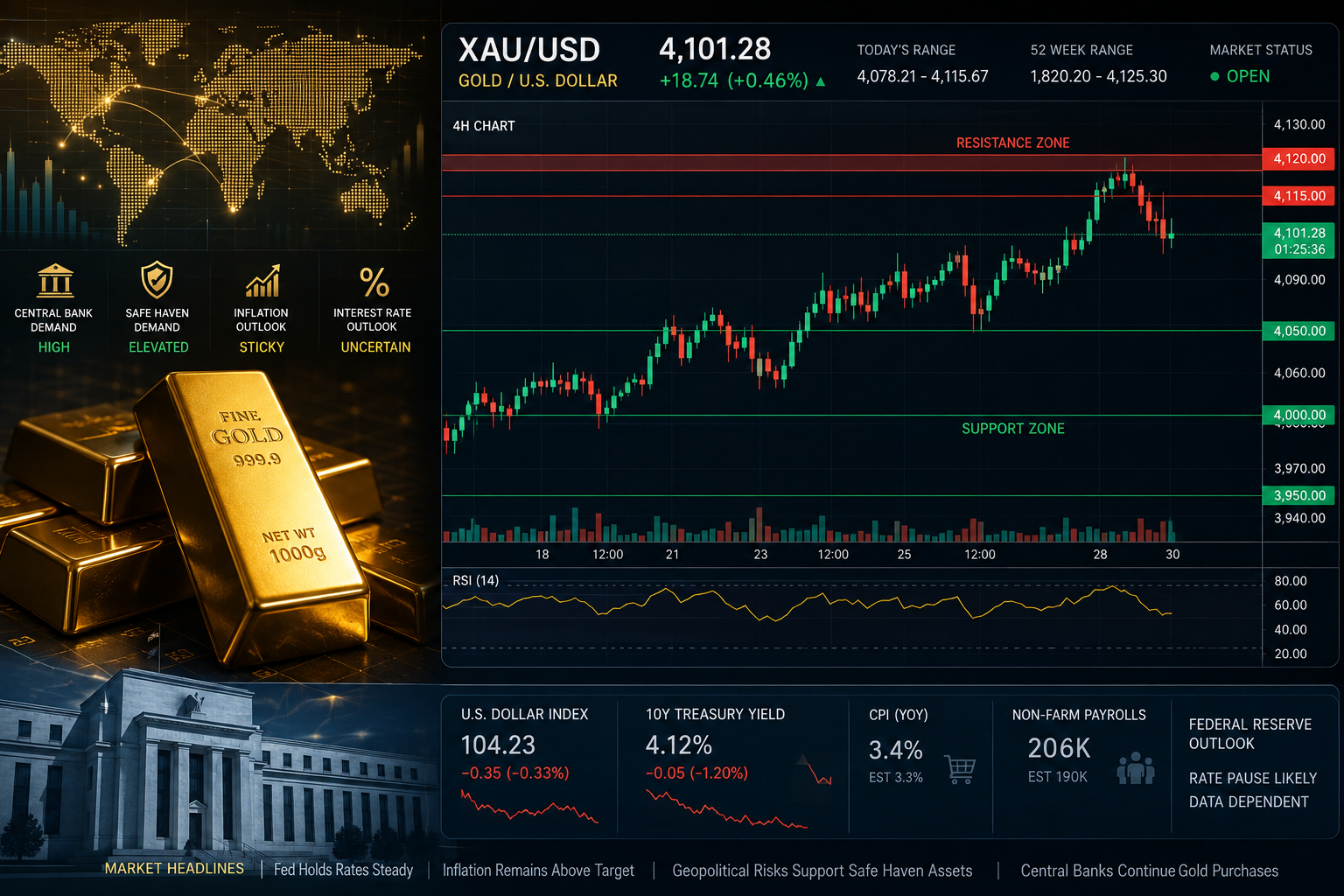
Gold price forecast today: Gold prices remain highly sensitive to interest rate expectations, U.S. dollar movements, Treasury yields, inflation data, and geopolitical developments. After the latest U.S. Federal Reserve meeting, gold rebounded sharply as the Fed kept interest rates unchanged, while a weaker U.S. dollar and lower Treasury yields supported buying interest. Spot gold recently traded above $4,100 per ounce, although volatility remains elevated.
Whether you’re an investor buying physical gold, a trader watching XAU/USD, or simply wondering if now is a good time to buy gold, this guide explains today’s market, the key price levels to watch, and what could move gold next.
| Factor | Current Outlook |
|---|---|
| Short-term Trend | Bullish but volatile |
| Medium-term Trend | Neutral to Bullish |
| Long-term Trend | Bullish while uncertainty remains |
| Biggest Support | Around the psychological $4,000 area |
| Key Resistance | Around $4,115–$4,120 area |
| Main Drivers | Fed policy, USD, Treasury yields, inflation, geopolitics |
Markets change quickly. Always verify live prices before making trading or investment decisions.
Gold is reacting to several major market forces.
The biggest catalyst recently has been the Federal Reserve’s decision to leave interest rates unchanged.
Although policymakers maintained a cautious stance on inflation, markets initially focused on the policy pause, which weakened the U.S. dollar and supported gold prices.
When interest rates stop rising:
Gold and the U.S. dollar usually move in opposite directions.
A weaker dollar makes gold cheaper for international buyers, increasing demand.
If the dollar strengthens again, gold could face renewed selling pressure.
Gold pays no interest.
When Treasury yields fall, investors often shift money toward gold.
When yields rise, gold can struggle.
Persistent inflation remains supportive for gold over the long term because investors use it as a store of value.
However, high inflation can also lead to tighter monetary policy, creating short-term volatility.
Global uncertainty continues supporting demand for safe-haven assets.
Events involving:
can quickly increase gold buying.
Recent market activity suggests traders are closely watching the following zones.
| Level | Importance |
|---|---|
| Around $4,000 | Major psychological support |
| Around $4,050 | Short-term buying zone |
| Around $4,100 | Current trading region |
| Around $4,115–$4,120 | Important resistance |
| Above $4,120 | Could strengthen bullish momentum |
Recent trading discussions also highlight the $4,100–$4,117 region as an area where buyers and sellers are actively competing, increasing the chance of sharp moves if price breaks decisively in either direction.
Current technical conditions suggest:
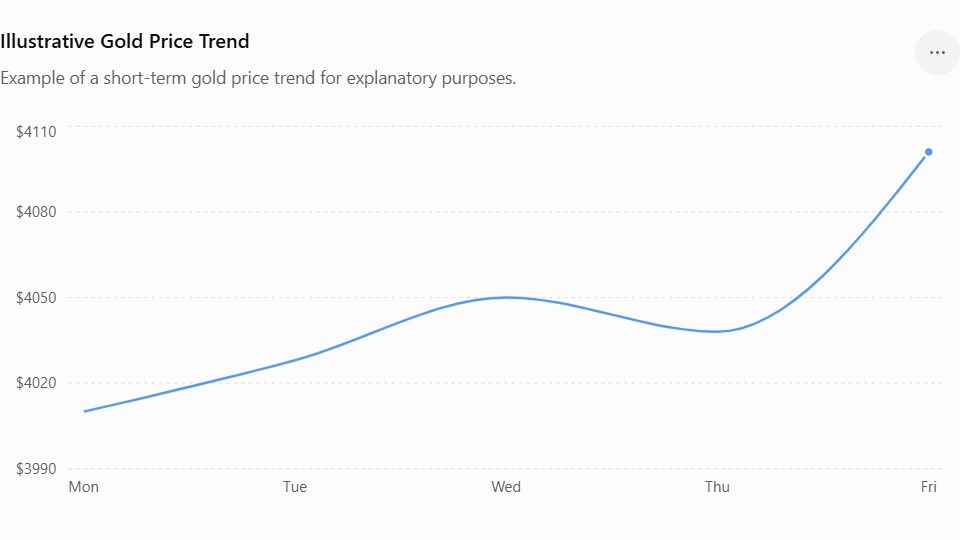
The next major catalysts include:
Higher-than-expected inflation can create larger price swings.
Non-Farm Payrolls (NFP)
Strong jobs numbers often strengthen the dollar.
Weak employment data can support gold.
Markets carefully analyze every comment from Fed officials for clues about future interest rates.
Central banks have increased gold purchases in recent years.
Continued buying supports long-term demand.
The answer depends on your goal.
Gold remains attractive if you want:
Wait for confirmation near major support or resistance rather than chasing sudden moves.
Watch:
Resistance
$4,120
──────────────
$4,115
──────────────
Current Price
$4,101
──────────────
$4,050
Support
──────────────
$4,000
Major Support
| Scenario | What Could Happen |
|---|---|
| Bullish | Softer dollar, lower yields, geopolitical uncertainty, weaker economic data |
| Bearish | Strong dollar, rising yields, hawkish Fed, stronger-than-expected economic reports |
| Gold | Bitcoin |
|---|---|
| Lower volatility | Higher volatility |
| Traditional safe haven | Growth-focused digital asset |
| Inflation hedge | Speculative investment |
| Favored during uncertainty | Favored during risk-on markets |
Many diversified investors hold both rather than treating them as direct substitutes.
Avoid these mistakes:
Artificial intelligence models are increasingly used to analyze gold markets by combining price history with macroeconomic indicators. While AI can identify trends and probabilities, it cannot predict unexpected events such as geopolitical conflicts or surprise central bank decisions. Treat AI forecasts as one input—not a guarantee.
Recent market commentary suggests that while the Fed’s pause provided short-term support, future inflation data and interest-rate expectations remain the dominant drivers of gold prices. Investors should monitor upcoming economic releases rather than relying on a single headline.
Gold may remain supported if the U.S. dollar weakens and Treasury yields stay lower. However, economic data releases can quickly change market direction.
Gold reacts to:
Many investors continue using gold for diversification and inflation protection, although no investment is risk-free.
The most important factors include:
If inflation remains elevated, the dollar weakens, or geopolitical risks increase, gold could challenge higher price levels over time. Future price action will depend on economic conditions and central bank policy.
Gold remains one of the world’s most closely watched safe-haven assets. The recent rebound following the Federal Reserve’s decision shows that monetary policy continues to play a central role in price direction. At the same time, inflation, Treasury yields, the U.S. dollar, and geopolitical developments will likely determine whether the next move is higher or lower.
Rather than reacting emotionally to daily price swings, investors should combine technical analysis with macroeconomic fundamentals, monitor major economic events, and follow a disciplined risk management strategy.