
 11
11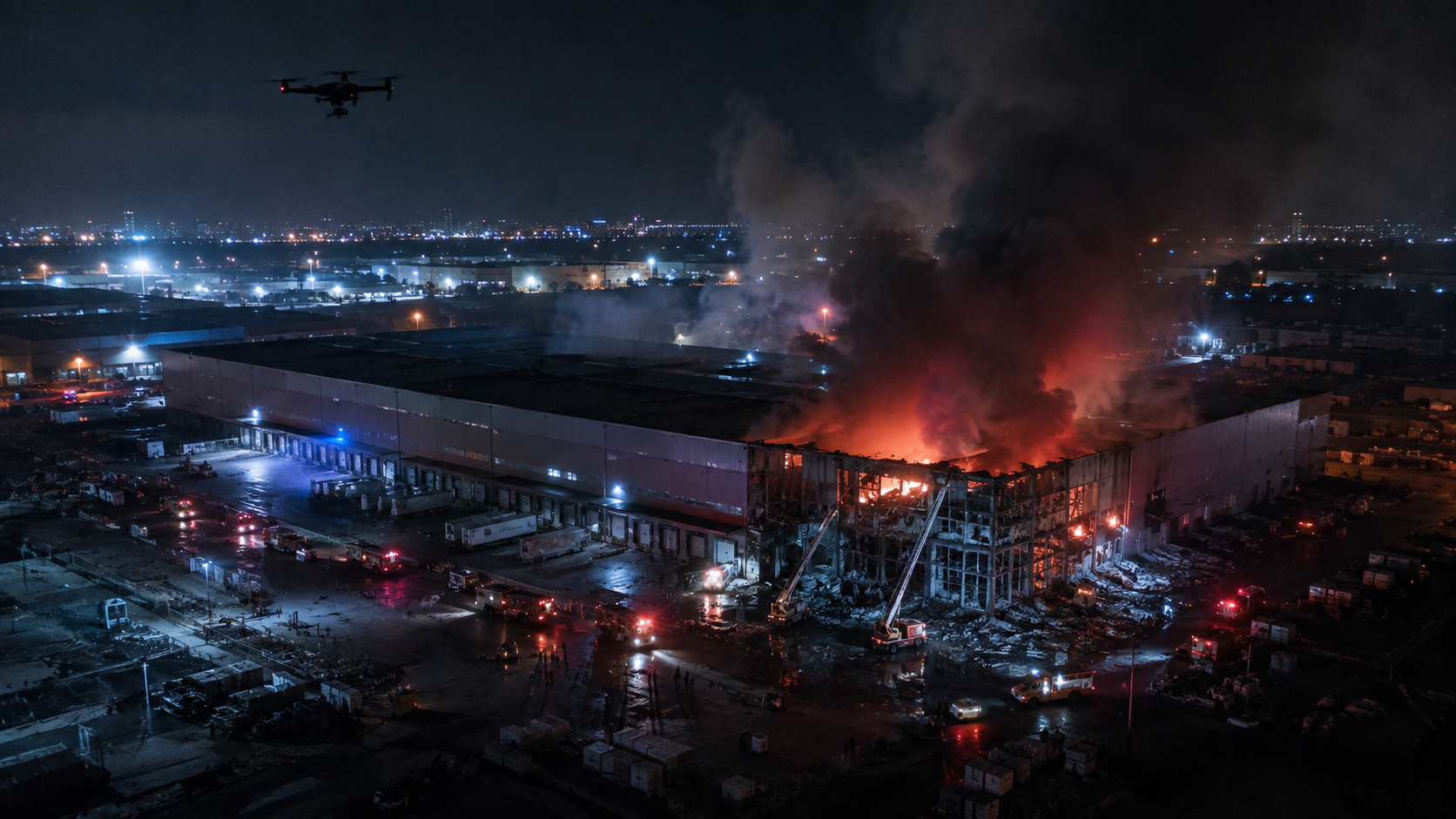
Russia’s war infrastructure is increasingly being tested far beyond the battlefield. In recent days, Ukraine’s expanding drone campaign has moved deeper into Russia’s commercial and logistics networks, with multiple facilities belonging to Ozon, one of Russia’s largest online retailers, reportedly coming under attack. On August 24, Ozon said that four of its logistics hubs in southern Russia had been targeted by Ukrainian drones, bringing the number of its facilities targeted since August 22 to six,
The reported attacks affected facilities in Makhachkala, Adygeysk, Nevinnomyssk and Enem. A fire broke out at the Makhachkala facility, where several people were reportedly injured and operations were halted. A major fire was also reported at another facility in Enem, while warehouses in Adygeysk and Nevinnomyssk were evacuated but were not reported as damaged. The significance of these attacks extends far beyond damaged buildings. They highlight a potentially consequential evolution in Ukraine’s long-range drone strategy: pressure on the economic and logistical networks that help keep Russia’s enormous domestic infrastructure moving.
And that raises a much bigger question.
Could logistics networks and commercial infrastructure become an increasingly important front in the war?
For much of the war, international attention has focused on military positions, air bases, oil refineries, ammunition facilities and infrastructure directly connected to the conflict. However, modern warfare does not operate only at the front line. Large-scale military activity depends on an enormous ecosystem of transportation, warehousing, communications, manufacturing and supply networks. That is why logistics has always been strategically important. A military force cannot function efficiently without fuel, equipment, transportation and the infrastructure required to move resources.
In the 21st century, those networks are increasingly interconnected with civilian and commercial systems. Ukraine has argued that some commercial infrastructure can form part of broader economic and supply networks supporting Russia’s war effort. Russia, meanwhile, has condemned attacks on what it describes as civilian infrastructure. The distinction is politically and strategically important. Yet the emergence of drone warfare is making that distinction increasingly complex.
According to Ozon’s statement reported by Reuters, the latest incidents involved four logistics hubs in southern Russia. The facility in Makhachkala, Dagestan, reportedly caught fire following a drone attack. Ozon said preliminary information indicated that several people were injured, and operations at the site were halted. Meanwhile, a large fire was also reported at an Ozon facility in Enem, in the Krasnodar region.
Workers were evacuated from facilities in Adygeysk, in the Adygeya region, and Nevinnomyssk, in the Stavropol region. Ozon said those facilities were not damaged. Individually, each incident is significant. Collectively, however, they reveal something more consequential. The number of Ozon facilities targeted since August 22 has reached six. That means the campaign was no longer limited to a single isolated incident.
The latest reported attacks followed incidents involving Ozon facilities in the Samara and Orenburg regions. On August 22, a logistics centre belonging to Ozon in the Samara region was struck, marking the first reported attack on the company during the latest campaign. Operations at the affected centre were halted, and injuries were reported. A day later, authorities in the Orenburg region said industrial facilities had been hit by drone debris, including an Ozon warehouse. The company said that more than 300 people were evacuated and operations at the affected logistics centre were suspended.
Within a remarkably short period, the number of affected locations had expanded. For a major online retailer, logistics centres are not simply storage buildings. They are part of an intricate network responsible for receiving goods, sorting products and moving millions of items through the country. When one large hub stops operating, the consequences can extend well beyond the physical site.
The modern e-commerce economy depends on speed. Customers expect products to move rapidly from sellers to warehouses, from warehouses to sorting centres and eventually to delivery points. That makes logistics infrastructure one of the invisible engines of modern commerce. A major disruption can potentially create:
For a company with an extensive logistics network, one damaged facility may not cripple the entire system. Nevertheless, repeated disruptions across multiple regions can create a far more complicated operational challenge. Companies must redirect shipments. Employees may need to be evacuated. Alternative facilities may need to absorb additional volumes. Damaged infrastructure must be inspected and repaired. Security procedures may become more expensive. The cumulative effect can be considerably more disruptive than a single attack suggests.
The attacks also had an immediate financial impact. Reuters reported that shares in Ozon fell by as much as 12% on the Moscow Exchange following news of the latest attacks. Shares in AFK Sistema, Ozon’s major shareholder, also declined by nearly 13%, according to the report. Financial markets often react rapidly to uncertainty. And uncertainty is precisely what repeated infrastructure attacks can create. Investors do not only evaluate what has already been damaged.
They also attempt to calculate what could happen next. Will operations remain disrupted? Could more facilities be targeted? Will security costs rise? Could supply chains face further interruptions? How expensive will repairs become? These questions can produce market volatility long before the full economic consequences become clear.
The strikes against Ozon come amid a broader campaign involving long-range Ukrainian drone operations inside Russia. Ukraine has repeatedly targeted facilities that it says contribute to Russia’s military and economic capacity. Oil infrastructure has been a particularly prominent target. However, logistics and warehouse networks are now receiving increased attention.
Ozon is the second major Russian e-commerce company to reportedly face such attacks after its larger rival, Wildberries. Reuters reported that the strikes on Ozon followed weeks of attacks involving Wildberries facilities.
That pattern is difficult to ignore.
It suggests that Ukraine’s strategy may increasingly involve economic and logistical pressure alongside traditional military objectives. Whether such attacks produce long-term strategic consequences remains uncertain. However, they demonstrate how inexpensive unmanned systems can threaten infrastructure located far from active front lines.
Drones are changing the geography of conflict. In the past, striking infrastructure deep inside another country’s territory often required expensive aircraft or long-range missiles. Those systems remain important. But drones have introduced a different equation.
They can potentially be produced in larger numbers and deployed against a wide range of targets. This does not mean every drone attack produces a decisive strategic result; far from it. Many drones can be intercepted. Others fail to reach their targets. Yet even the possibility of repeated attacks can create a substantial burden. Air defence systems must be deployed. Workers may be evacuated.
Facilities may need additional protection. Companies may need contingency plans. Insurance and security costs may rise. In this sense, the psychological and economic impact can sometimes extend beyond the physical damage. A logistics network does not need to be completely destroyed to experience disruption. Sometimes, uncertainty alone can force costly changes.
Russia is geographically vast. That creates both strengths and vulnerabilities. A large territory allows infrastructure to be spread across enormous distances. However, it also creates a formidable defensive challenge. Protecting every refinery, warehouse, industrial site, logistics centre and transportation facility across such a large country is extraordinarily difficult. Ukraine’s growing long-range drone capabilities have added another layer of pressure.
Russian air defences must make strategic decisions about which areas and assets receive the greatest protection. No country can place maximum protection around every commercial building. That creates what military analysts often describe as an asymmetry problem. An attacker can choose where to concentrate. The defender must protect many possible targets. This does not guarantee success for the attacking side. However, it can force the defending side to spread resources across a wider area.
The attacks on e-commerce facilities raise an uncomfortable question about modern conflict. Where does the civilian economy end and strategic infrastructure begin? Large companies can operate enormous transportation and warehousing networks. Those networks may primarily serve civilian consumers.
At the same time, commercial infrastructure can exist within a broader national economic system that supports a country’s overall capacity. Ukraine has argued that its campaign is aimed at infrastructure supporting Russia’s war effort. Russia rejects such characterizations and describes attacks on commercial facilities as strikes on civilian infrastructure. These competing narratives are now becoming an increasingly prominent part of the conflict. The debate matters because the modern economy is deeply interconnected.
The same roads can transport civilian products and military equipment. The same industrial facilities can have multiple functions. The same logistics networks can support different sectors of the economy. As a result, the strategic landscape has become increasingly ambiguous.
One of the most interesting questions surrounding repeated logistics disruptions is whether they could eventually affect ordinary consumers. At this stage, it is too early to determine the long-term consumer impact of the latest attacks. However, logistics disruptions can potentially influence delivery times and operational costs.
If disruptions become frequent and widespread, companies may be forced to reorganize parts of their supply networks. That could become increasingly expensive. For major retailers, resilience depends on redundancy. Can another warehouse handle additional orders? Can deliveries be rerouted? Are alternative transportation routes available? How quickly can a damaged facility return to operation?
The answers to these questions could determine how much disruption reaches customers. For now, the bigger strategic story is not necessarily the immediate impact on a single order. It is the growing pressure on the infrastructure that makes large-scale commerce possible.
Physical damage is only one dimension of drone warfare. The other is perception. Repeated attacks deep inside Russian territory demonstrate that locations far from the front line may still be vulnerable. That message can affect:
The objective of such campaigns can therefore be broader than destroying infrastructure. They can create uncertainty. And uncertainty itself has economic consequences. Companies may spend more on security. Governments may redirect resources. Investors may reassess risk. Workers may face repeated evacuations. In a prolonged conflict, these smaller pressures can accumulate.
It would be premature to conclude that the attacks on Ozon will fundamentally transform the course of the war. Large economies can absorb significant disruptions. Major companies can adapt. Damaged facilities can be repaired. Supply routes can be changed. Nevertheless, the recent incidents reveal a potentially important development.
Ukraine’s drone campaign appears to be demonstrating that strategic pressure can be applied to a much wider range of infrastructure than traditional military targets. That expands the battlefield concept. A warehouse hundreds or even thousands of kilometres from the front line may still become part of the strategic conversation. A logistics centre can become more than a commercial facility. It can become a symbol of vulnerability.
Perhaps the most important lesson from the Ozon attacks is that modern conflicts increasingly target networks.
Energy networks.
Transportation networks.
Communication networks.
Manufacturing networks.
Logistics networks.
Financial networks.
The most vulnerable point may not always be the largest building or the most obvious target. Sometimes, disruption can occur by placing pressure on the connections between different parts of a system. This is why logistics has become increasingly important. A factory can produce goods. But without transportation, warehousing, and distribution, those goods cannot move efficiently. Similarly, military and economic systems depend on interconnected infrastructure. The modern battlefield is increasingly a battlefield of networks.
The immediate future remains uncertain.
Ozon will likely continue assessing the operational impact of the latest incidents. Russian authorities will face continued pressure to protect important infrastructure. Ukraine may continue adapting its long-range drone strategy.
And companies operating large logistics networks may increasingly need to prepare for a security environment that would have seemed unimaginable only a few years ago. One thing, however, is becoming increasingly clear. The distance from the front line is no longer the same guarantee of security that it once was. Long-range drones have fundamentally altered that calculation.
The reported targeting of four additional Ozon logistics hubs is significant not simply because of the fires, evacuations, or temporary operational disruptions. It matters because of what it represents. Ukraine’s drone campaign appears to be expanding the range of infrastructure under strategic pressure. Commercial logistics networks are now becoming part of a much larger conversation about economic resilience and the changing nature of warfare. Six Ozon facilities were reportedly targeted between August 22 and August 24.
That number tells a story beyond individual warehouses. It suggests that the infrastructure supporting a modern economy can itself become a strategic vulnerability during a prolonged conflict. Whether these attacks produce lasting economic consequences remains to be seen. But their symbolic impact is already unmistakable. The battlefield is no longer defined only by where soldiers stand. It is increasingly defined by the networks, infrastructure and economic arteries that allow an entire country to function. And in the age of long-range drones, those arteries may be far more exposed than they once were. The war is still being fought on the ground. But increasingly, the struggle is also being fought against the infrastructure behind it.